
Salary Sacrifice Super: How It Works, What It Saves, and the $32,500 Cap
By Easha · Tax accountant, Sydney
Salary sacrifice sends part of your before-tax pay into super, where it's taxed at 15% instead of your marginal rate. Here's how salary sacrifice super works in 2026–27, with two worked examples and the $32,500 concessional cap.
Key takeaways
- Salary sacrifice is an agreement to give up part of your before-tax pay in exchange for extra super contributions from your employer.
- The sacrificed amount is not counted as your assessable income — it is taxed at 15% inside your super fund instead of your marginal rate (30%, 37% or 45%).
- On a $100,000 salary, sacrificing $10,000 saves $1,700 in total tax.
- Salary sacrifice does not reduce your super guarantee — your employer still owes the full 12% on your ordinary time earnings.
- Everything counts towards one cap: the $32,500 concessional contributions cap for 2026–27 covers super guarantee, salary sacrifice and deductible personal contributions combined.
- The arrangement must be agreed before you do the work, usually in writing — you cannot sacrifice pay you have already earned.
Salary sacrifice sounds like a pay cut. It is the opposite: you give up part of your salary before tax, and your employer pays that amount into your super fund instead. Because the money never counts as your income, it escapes your marginal tax rate — and is taxed at 15% inside your fund instead. For most people that gap is worth hundreds or thousands of dollars a year.
This is general information, not tax or financial advice. The figures come from the ATO pages linked below — check them, or speak to a registered tax agent, for your own circumstances.
How salary sacrifice works
You and your employer agree — usually in writing, before you do the work — that part of your salary or wages will be paid into your super fund instead of to you. The ATO calls this an effective salary sacrifice arrangement, and three things make it effective:
- The agreement is made before you perform the work
- There is an agreement between you and your employer, usually written
- You cannot access the sacrificed salary — it goes straight to the fund
If the arrangement is not effective, the ATO treats the amount as ordinary salary and taxes it at your marginal rate anyway. You also cannot sacrifice pay you have already earned — it only works for future pay.
The sacrificed amount is not counted as assessable income, so no PAYG withholding is taken from it. Your fund taxes it at 15% as a concessional contribution. And because it goes to a complying super fund, it is not a fringe benefit and no fringe benefits tax applies.

Part of your pay goes to your wallet, part goes to super — and the super part is taxed at 15% instead of your marginal rate.
Worked example 1: a $100,000 salary, sacrificing $10,000
Say you earn $100,000 and agree to sacrifice $10,000 a year into super. Your taxable income drops to $90,000:
| No sacrifice | Sacrifice $10,000 | |
|---|---|---|
| Taxable income | $100,000 | $90,000 |
| Income tax (2026–27 rates) | $20,520 | $17,520 |
| Medicare levy (2%) | $2,000 | $1,800 |
| Tax in super fund (15% of $10,000) | — | $1,500 |
| Total tax | $22,520 | $20,820 |
| Saving | $1,700 |
The saving is simple arithmetic: the $10,000 would have been taxed at 30% income tax plus 2% Medicare levy ($3,200). Inside super it is taxed at 15% ($1,500). The difference — $1,700 — stays in your super balance, compounding for retirement.
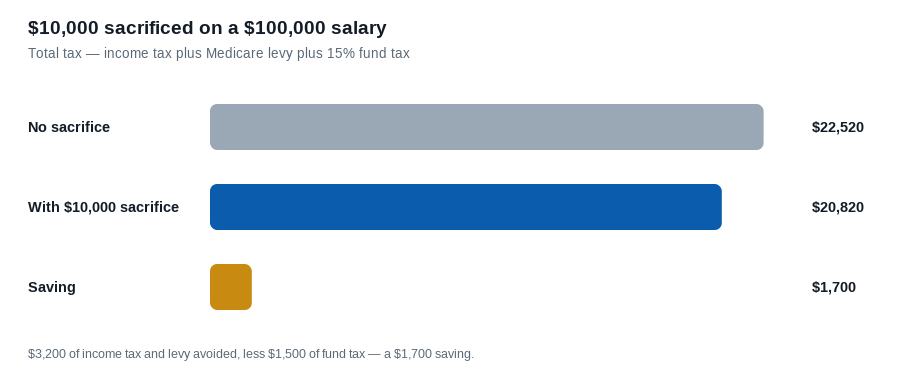
The $10,000 sacrifice costs $1,500 of tax inside super instead of $3,200 of income tax and levy — a $1,700 saving.
Meanwhile your employer still pays super guarantee on your full ordinary time earnings: 12% of $100,000 = $12,000. Your total concessional contributions are $12,000 super guarantee + $10,000 sacrifice = $22,000 — comfortably under the $32,500 cap, with $10,500 of headroom left.
Worked example 2: a $140,000 salary, sacrificing $15,000
At higher incomes the saving grows — but the cap gets tighter. Say you earn $140,000 and sacrifice $15,000:
| No sacrifice | Sacrifice $15,000 | |
|---|---|---|
| Taxable income | $140,000 | $125,000 |
| Income tax (2026–27 rates) | $32,870 | $28,020 |
| Medicare levy (2%) | $2,800 | $2,500 |
| Tax in super fund (15% of $15,000) | — | $2,250 |
| Total tax | $35,670 | $32,770 |
| Saving | $2,900 |
The $15,000 spans two tax brackets — $5,000 of it would have been taxed at 37% and $10,000 at 30% — plus 2% levy, so the income tax and levy saved is $5,150, less the $2,250 fund tax.
But watch the cap: super guarantee of 12% × $140,000 = $16,800, plus the $15,000 sacrifice, is $31,800 — only $700 under the $32,500 cap. One extra contribution, or a pay rise, and you are over. This is the trap for higher earners: the higher your salary, the more of your cap super guarantee already uses.
The $32,500 concessional cap
From 1 July 2026 the concessional (before-tax) contributions cap is $32,500 a year. It is one shared cap across all your funds, and it covers everything before-tax:
- Your employer’s super guarantee (12% of ordinary time earnings)
- Your salary sacrifice amounts
- Any personal contributions you claim as a tax deduction
There is no limit on how much you can salary sacrifice — unless your contract says so — but anything over the cap is taxed at your marginal rate less a 15% offset, plus interest. You can choose to withdraw up to 85% of the excess from your fund, or leave it in, where it then counts towards your after-tax contributions cap.
How much room is left after super guarantee depends on your salary:
| Salary | Super guarantee (12%) | Cap room left for sacrifice |
|---|---|---|
| $80,000 | $9,600 | $22,900 |
| $100,000 | $12,000 | $20,500 |
| $140,000 | $16,800 | $15,700 |
| $200,000 | $24,000 | $8,500 |
| $270,830 | $32,500 | ~$0 |
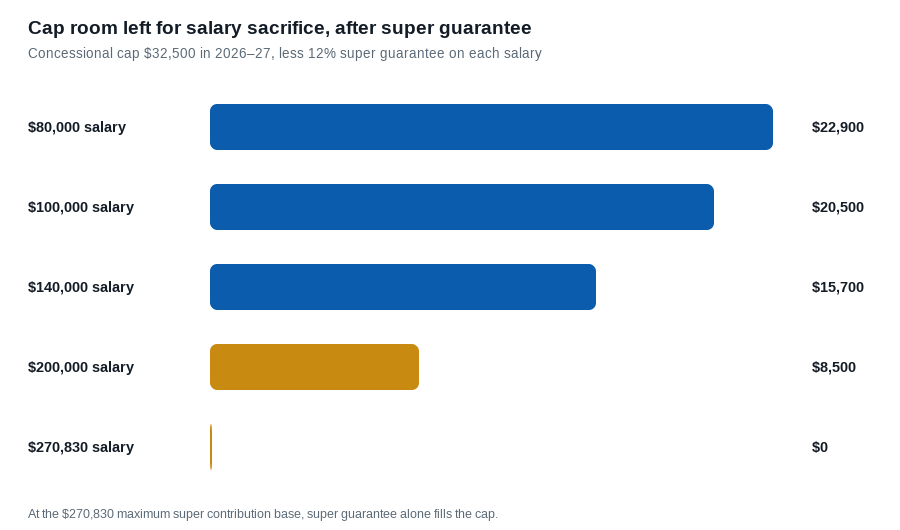
At the maximum super contribution base of $270,830, super guarantee alone fills the $32,500 cap — there is no room left to sacrifice.
The $270,830 figure is the maximum super contribution base: the most of your earnings your employer is required to pay super guarantee on. Above it, no more compulsory super is owed — though some awards and agreements still require it.
Carry forward: using last year’s unused cap
If your total super balance was less than $500,000 at 30 June last year, you can carry forward unused concessional cap from up to the previous five financial years. Unused amounts are used oldest first, and they expire after five years.
Example: in 2025–26 your only concessional contribution was $12,000 of super guarantee, against a $30,000 cap — leaving $18,000 unused. In 2026–27 you could contribute up to $32,500 + $18,000 = $50,500 before extra tax applies. Check your available carry-forward amounts in ATO online services through myGov.
Division 293: the extra 15% for high earners
If your income plus concessional super contributions is more than $250,000 for Division 293 purposes, an extra 15% tax applies to your concessional contributions — so they are taxed at 30% inside the fund instead of 15%. Salary sacrifice still saves tax at a 45% marginal rate (45% versus 30%), but the saving shrinks to 15 cents in the dollar. See our guide to Division 296 super tax for the separate tax on very large balances from 1 July 2026.
What salary sacrifice does not do
Three things people get wrong:
- It does not reduce your super guarantee. Sacrificed amounts do not count towards the super guarantee your employer owes, and they do not reduce the ordinary time earnings the guarantee is calculated on. Your employer must still pay the full 12%.
- It does not cut your HECS/HELP repayments. Salary sacrifice reduces your taxable income, but your HELP repayment is worked out on repayment income — which includes reportable super contributions. Sacrificing does not shrink the repayment. See our guide to HECS/HELP repayment in 2026–27.
- It does not hide income from family payments. Reportable super contributions count in the income tests for Family Tax Benefit and the Child Care Subsidy, so sacrificing can reduce those payments. And the sacrificed amount still appears on your payment summary as a reportable super contribution — include it in your tax return.

Salary sacrifice is a slow build: small amounts each payday, taxed at 15%, compounding for decades.
Setting it up
- Check your cap room first — work out your super guarantee for the year and subtract it from $32,500, plus any carry-forward amounts. myGov shows your contributions and carry-forward balance.
- Agree it in writing with your employer before the pay period it covers. Most employers have a salary packaging form; some use a salary packaging provider.
- Pick an amount you can sustain — a fixed dollar amount per pay is simplest, and you can usually change it during the year by agreement.
- Check your payslip — the sacrificed amount should appear as a reportable super contribution, and your super guarantee should still be calculated on your full ordinary time earnings.
- Watch the cap across the year — if you change jobs, both employers’ contributions count towards the same $32,500 cap.
The money is locked away until you meet a condition of release, usually retirement — that is the trade-off for the tax saving. If you need the cash before then, salary sacrifice is the wrong tool.
FAQs about salary sacrifice super
How much can I salary sacrifice into super?
There is no legal limit, unless your contract or award sets one. The practical limit is the $32,500 concessional cap for 2026–27, shared with your super guarantee and any deductible personal contributions. Go over it and the excess is taxed at your marginal rate less a 15% offset.
Is salary sacrifice better than making a personal deductible contribution?
The tax result is the same — both are concessional contributions taxed at 15% in the fund. Salary sacrifice happens automatically through payroll and also reduces your Medicare levy; a personal contribution needs a notice of intent to claim a deduction, given to your fund by the earlier of lodging your return and 30 June the following year, and the fund must receive the money by 30 June.
Does salary sacrifice reduce my super guarantee?
No. Sacrificed amounts do not reduce the ordinary time earnings your employer calculates super guarantee on, and they do not count towards the guarantee. Your employer still owes the full 12%.
What happens if I go over the $32,500 cap?
The excess is included in your assessable income and taxed at your marginal rate, with a non-refundable offset of 15% for the tax already paid by the fund, plus interest. You can elect to release up to 85% of the excess from your super fund.
Can I salary sacrifice if I earn under $250,000?
Yes — most people who sacrifice earn well under $250,000. The $250,000 figure is the Division 293 threshold, where an extra 15% tax applies to concessional contributions. Below it, sacrificed amounts are taxed at 15% in the fund.
Does salary sacrifice affect my take-home pay?
Yes, your take-home pay falls — but by less than the amount sacrificed, because less tax is withheld. Sacrificing $10,000 on a $100,000 salary cuts take-home pay by about $6,800 a year, while $10,000 lands in super (less the 15% fund tax).
This post is general information, not tax or financial advice. Figures are from the ATO as at 24 November 2026, for the 2026–27 income year unless stated otherwise. Check the ATO pages below or speak to a registered tax agent for your own circumstances.
Sources: ATO, Salary sacrificing super; ATO, Concessional contributions cap; ATO, Super guarantee; ATO, Tax rates – Australian residents.
Want to check your own pay and tax? Use our free Weekly Tax Calculator or browse the Tax Blog.
Calculate Your Exact Weekly Tax
Enter your pay details and instantly see your PAYG tax, Medicare levy, and take-home pay.
Open the Calculator