
Rental Property Tax Deductions: What You Can Claim in 2026–27
By Easha · Tax accountant, Sydney
Rental property deductions fall into three ATO categories — claim now, claim over several years, or never claim. Here's the full list, a worked example showing a $1,850 rental loss, and the mistakes the ATO sees most often.
Key takeaways
- The ATO sorts rental expenses into three buckets: claim now (loan interest, rates, repairs), claim over several years (capital works, borrowing expenses, decline in value), and never claim (personal expenses, second-hand depreciating assets bought after 9 May 2017, holding costs for vacant land).
- Only the interest on your investment loan is deductible — never the loan repayments themselves.
- In our worked example, $30,000 of rent against $31,850 of deductions leaves a $1,850 rental loss, which offsets other income in 2026–27 and saves $555 of tax at a 30% marginal rate.
- If you use the property yourself for part of the year, or rent out only part of it, you must apportion your expenses on a fair and reasonable basis — time-based, area-based, or both.
- The ATO has said 9 out of 10 rental property tax returns had an error. The most common mistakes are claiming repairs that are really improvements, claiming travel to the property, and claiming the full loan principal instead of just the interest.
If you own a rental property, the tax return is where a lot of the money is. Get the deductions right and a property that loses money on paper can still put cash back in your pocket at tax time. Get them wrong and the ATO — which matches rental data from banks, property managers and state revenue offices — is likely to notice.
The good news is that the ATO’s rules are organised around one simple idea: every rental expense falls into one of three buckets, depending on when you can claim it. Learn the three buckets and most of the confusion goes away.
This is general information, not tax or financial advice. The figures come from the ATO pages linked below — check them, or speak to a registered tax agent, for your own circumstances.
The three buckets
The ATO groups rental expenses by timing. Before you claim anything, work out which bucket it sits in.
| Bucket | What goes in it | Examples |
|---|---|---|
| Claim now — deduct in the year you incur the expense | Day-to-day costs of owning and running the rental | Loan interest, council and water rates, land tax, insurance, property management and agent fees, advertising for tenants, repairs and maintenance, depreciating assets costing $300 or less |
| Claim over several years — spread the deduction out | Bigger, longer-lived costs | Capital works (generally 2.5% a year over 40 years), borrowing expenses over $100 (over 5 years or the loan term, whichever is shorter), decline in value of depreciating assets costing more than $300 |
| Never claim | Private or excluded costs | Your personal use of the property, travel to inspect the property, the loan principal you repay, second-hand depreciating assets bought after 9 May 2017, holding costs for vacant land |

Every rental expense fits in one of three buckets: claim now, claim over several years, or never claim.
Claim now: the everyday costs
These are the expenses you deduct in full in the year you pay them, as long as the property was rented — or genuinely available for rent — when you incurred them.
- Loan interest. The interest on the money you borrowed to buy the rental property. If part of the loan was for private purposes — say you redrew to buy a car — only the rental share of the interest is deductible.
- Council rates, water and sewerage rates, land tax and emergency service levies.
- Insurance — building, contents and landlord insurance premiums.
- Agent fees and commissions, advertising for tenants, and the cost of finding a tenant.
- Repairs and maintenance — fixing something that wore out or was damaged while the property was rented, like repainting faded walls, replacing a cracked window pane or patching part of a fence.
- Depreciating assets costing $300 or less — a new smoke alarm or a cheap appliance, for example.
One trap: you can claim these expenses even before the property is first rented, provided you are holding it to produce rental income — for instance, while it is advertised with a real estate agent. You cannot claim them if you have decided not to rent it out at all.
Claim over several years: the slow-burn costs
Some costs are too big, or too long-lived, to deduct all at once. The ATO spreads them out.
Capital works — 2.5% a year over 40 years
Capital works are the building itself and structural improvements: extensions, renovations, a new fence, a driveway, a retaining wall. For residential construction that started after 15 September 1987, you generally claim 2.5% of the construction cost each year for 40 years, starting only once the construction is complete. Construction that started between 18 July 1985 and 15 September 1987 is claimed at 4% over 25 years instead.
The deduction is based on the actual construction cost — never the purchase price of the property. If you buy an established property, a quantity surveyor’s report is the usual way to work out the construction cost.
Borrowing expenses — over 5 years
The costs of taking out the loan — loan establishment fees, lender’s mortgage insurance, title search fees, mortgage broker fees, valuation fees for loan approval and stamp duty on the mortgage — are borrowing expenses. If they total more than $100, you spread them over 5 years or the term of the loan, whichever is shorter. If they are $100 or less, you claim the lot in the year you incur them.
What you cannot claim as borrowing expenses: the amount you borrowed, your loan repayments, the interest (claimed separately), and the stamp duty on the transfer of the property title — that last one is a capital expense that forms part of the property’s cost base for capital gains tax.
Decline in value — assets over $300
Bigger depreciating assets — a hot water system, an air conditioner, new carpet — are claimed over their effective life as their value declines. Only assets costing $300 or less can be written off immediately. And since 9 May 2017, you cannot claim the decline in value of second-hand depreciating assets in a property you buy — if the previous owner already used the dishwasher, its decline in value is not your deduction.
Never claim: the costs that stay yours
- Loan principal. You repay the bank, but only the interest is deductible — never the principal.
- Personal expenses, including any cost of using the property yourself.
- Travel to inspect the property. Since 1 July 2017, travel expenses for inspecting, maintaining or collecting rent for a residential rental property are not deductible.
- Holding costs for vacant land — you generally cannot claim deductions for expenses incurred while the land is vacant and no property on it can be occupied and rented out.
- Initial repairs. Work you do to fix damage that already existed when you bought the property is not an immediately deductible repair — it is a capital expense, often claimed as capital works at 2.5% a year.
Worked example: a $1,850 rental loss
Here is a typical year for a property rented out for the full year.
| Amount | |
|---|---|
| Rent received | $30,000 |
| Loan interest | −$18,000 |
| Council and water rates | −$2,500 |
| Insurance | −$1,200 |
| Agent fees | −$2,400 |
| Repairs | −$1,500 |
| Capital works (2.5% × $250,000 construction cost) | −$6,250 |
| Total deductions | −$31,850 |
| Net rental result | −$1,850 |

Loan interest is the biggest deduction by far — and only the interest, never the loan repayments, is deductible.
The deductions ($31,850) are bigger than the rent ($30,000), so the property makes a rental loss of $1,850. In 2026–27 that loss offsets your other income — salary, for example. At a 30% marginal tax rate, the loss saves $555 of tax ($1,850 × 30%). At 37%, it saves $684.50.
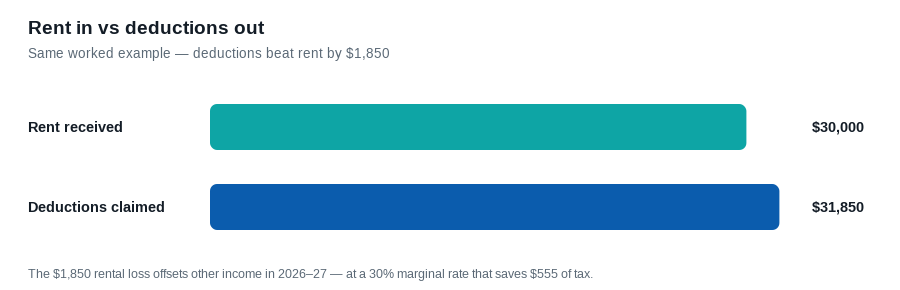
The $1,850 rental loss offsets other income in 2026–27 — at a 30% marginal rate that saves $555 of tax.
That is negative gearing in its simplest form — and it is why getting the deductions right matters so much. But note the timing: from 1 July 2027, new rules quarantine rental losses so they can only offset future rental income, not salary. See our guide to negative gearing in 2027 for what changes and when.
Apportioning: when the property is not rented all year
If the property was only rented for part of the year, or you used part of it yourself, you can only claim the rental share of your expenses. The ATO accepts two methods, and sometimes you need both.
Time-based. Multiply your expenses by the share of the year the property was rented or held for rent. The ATO’s own example: Gail and Craig own a holiday home they also use themselves for 30 days a year. It is rented or held for rent for 335 days. Their expenses are $34,800, plus $1,828 of agent commission and advertising that relates solely to renting.
- 335 ÷ 365 × $34,800 = $31,940
- Plus the $1,828 claimed in full = $33,768 of deductions between them, or $16,884 each as equal co-owners.
Area-based. If you rent out only part of the property — a room, or one floor of a two-storey house — apportion by floor area, counting shared areas at half. The ATO’s example: Kim rents out the bottom floor (45 square metres) of a 135-square-metre townhouse, sharing 35 square metres of garden. Her share is [45 + (35 ÷ 2)] ÷ 135 = 46.3% of the allowable expenses.
If you rent out part of the property for only part of the year, you apply both methods — area first, then time.
Holiday homes: the “mainly for rent” test
A holiday home gets special attention. You can only claim ownership and use expenses — interest, rates, insurance — if the property is used, or held for use, mainly to produce rental income. That means genuinely advertising it, charging market rent, and not blocking out the best weeks for yourself and your family.
Gail and Craig pass the test because their agent actively chases bookings and they only use the house themselves in weeks when it is unlikely to be rented. A house that sits empty most of the year, or is only ever offered to friends at a discount, will fail it — and then none of the ownership expenses are deductible.

A holiday home only earns its deductions if it is used mainly to produce rental income — not mainly for your own holidays.
Co-owners split by legal interest
If you co-own the property, rental income and expenses are split according to each owner’s legal interest in the property — not according to who paid what. Joint tenants each declare 50%. If you own 70% and your partner owns 30%, you declare 70% of the rent and claim 70% of the deductions, even if you paid all the interest yourself.
The mistakes the ATO sees most often
The ATO has said 9 out of 10 rental property tax returns had an error. The usual suspects:
- Repairs vs improvements. Replacing a whole roof or a whole kitchen is an improvement — capital works at 2.5% a year — not a repair you can claim in full this year. Patching part of the roof is a repair.
- Claiming the loan, not the interest. Your monthly mortgage repayment is mostly principal. Only the interest portion is deductible.
- Claiming travel. Driving to the property to inspect it or collect rent is not deductible.
- Claiming the full cost of second-hand assets. The previous owner’s dishwasher, curtains and oven do not come with a deduction for you.
- Forgetting to apportion. A few weeks of personal use, or a room kept for yourself, means part of every shared expense is private.
- Claiming expenses for a property that was never genuinely available for rent. A house you decided not to rent, or that sat empty with no advertising, earns no deductions.
FAQs about rental property deductions
Can I claim the mortgage repayments on my rental property?
No — only the interest. The principal you repay is not a tax deduction. If your loan is interest-only, the whole repayment is interest, but on a principal-and-interest loan you need to split it.
What is the difference between a repair and an improvement?
A repair restores something to how it was — fixing a broken window, repainting a faded wall. An improvement makes it better than it was, or replaces a whole thing — a new kitchen, a whole new fence. Repairs are deductible now; improvements are capital works at 2.5% a year over 40 years.
Can I claim deductions if my rental property is empty?
Yes, if it is genuinely available for rent — advertised at market rent through an agent, for example. Days it is empty but available still count. If it is empty because you decided not to rent it, or because the land is vacant, you generally cannot claim holding costs.
How much of my rental loss can I claim against my salary?
In 2026–27, the whole loss offsets your other income. A $1,850 rental loss at a 30% marginal rate saves $555 of tax. From 1 July 2027, new rules quarantine rental losses to future rental income instead — see our negative gearing 2027 guide.
Do I need a quantity surveyor’s report?
Not legally, but it is the usual way to work out the construction cost behind a capital works deduction on an established property, and to list the depreciating assets and their values. Without one, most owners cannot support a capital works claim if the ATO asks.
What records do I need to keep?
Keep receipts, bank and loan statements, agent statements, advertising records and any quantity surveyor’s report for five years from when you lodge. If you claim capital works or decline in value, keep the construction cost records too — they also feed into the property’s cost base when you sell.
This post is general information, not tax or financial advice. Figures are from the ATO as at 23 November 2026, for the 2026–27 income year unless stated otherwise. Check the ATO pages below or speak to a registered tax agent for your own circumstances.
Sources: ATO, How to claim rental expenses; ATO, Capital expenses; ATO, Borrowing expenses.
Want to check your own pay and tax? Use our free Weekly Tax Calculator or browse the Tax Blog.
Calculate Your Exact Weekly Tax
Enter your pay details and instantly see your PAYG tax, Medicare levy, and take-home pay.
Open the Calculator