HECS/HELP Repayment 2026–27: Rates, Thresholds and Worked Examples
By Easha · Tax accountant, Sydney
From 2026–27 you only repay HECS/HELP on income above $69,528 — 15 cents per dollar up to $129,717. The full 2026–27 table, worked examples, the 20% debt cut and 2.8% indexation explained.
Key takeaways
- In 2026–27 you repay nothing until your repayment income passes $69,528. Above that you pay 15 cents for each dollar up to $129,717, then $9,028 plus 17 cents per dollar up to $186,050, then 10% of your total repayment income.
- Repayments are now marginal — you only ever repay on the income above each threshold, never on your whole salary. The old “cliff”, where earning $1 over the threshold could trigger a repayment of hundreds of dollars, is gone.
- Repayment income is not the same as taxable income. Salary sacrifice, reportable fringe benefits and net investment losses are added back, so they do not reduce what you repay.
- The ATO has finished applying the 20% cut to study loan balances that existed on 1 June 2025. Indexation on 1 June 2026 was 2.8%, the lowest since 2021.
- Your employer withholds the repayment from your pay if you tell them you have a study loan on your tax file number declaration. Any difference is sorted out when you lodge your tax return.
If you studied at university or TAFE with a HECS-HELP, FEE-HELP or other study loan, the debt follows you into your working life — but only once you earn enough. And the rules changed in a big way from 1 July 2025: repayments are now worked out on a marginal basis, the same idea as income tax brackets. Most people now repay less than they did under the old system, and some no longer repay at all.
This guide covers the 2026–27 thresholds and rates, worked examples at real salaries, what counts as repayment income, the 20% debt cut, and how indexation works.
This is general information, not tax or financial advice. The figures come from the ATO pages linked below — check them, or speak to a registered tax agent, for your own circumstances.
The 2026–27 repayment thresholds and rates
| Repayment income | Compulsory repayment |
|---|---|
| $0 – $69,528 | Nil |
| $69,529 – $129,717 | 15c for each $1 over $69,528 |
| $129,718 – $186,050 | $9,028 plus 17c for each $1 over $129,717 |
| $186,051 and over | 10% of your total repayment income |
The minimum repayment income for 2026–27 is $69,528, up from $67,000 in 2025–26. The thresholds are indexed each year in line with average weekly earnings.
These rates apply to all study and training loans — HELP, VET Student Loans, Student Start-up Loans, ABSTUDY Student Start-up Loans and Australian Apprenticeship Support Loans — and the same thresholds apply to each.
How the marginal system works
Under the old system, your repayment rate applied to your entire repayment income. Cross a threshold by $1 and the higher rate hit your whole salary. In 2024–25, for example, a repayment income of $54,434 meant no repayment at all — but $54,435 triggered 1% of the whole amount, a $544.35 repayment for $1 of extra income. That was the cliff.
From 2025–26 onwards, you only repay on the income above each threshold. At $80,000 of repayment income in 2026–27, you pay 15% of the $10,472 above $69,528 — not a percentage of the full $80,000.
Worked examples: what you repay in 2026–27
| Repayment income | How it is worked out | Compulsory repayment |
|---|---|---|
| $65,000 | Below $69,528 | $0 |
| $69,528 | Exactly at the threshold | $0 |
| $70,000 | 15% × ($70,000 − $69,528) | $70.80 |
| $75,000 | 15% × ($75,000 − $69,528) | $820.80 |
| $80,000 | 15% × ($80,000 − $69,528) | $1,570.80 |
| $85,000 | 15% × ($85,000 − $69,528) | $2,320.80 |
| $90,000 | 15% × ($90,000 − $69,528) | $3,070.80 |
| $100,000 | 15% × ($100,000 − $69,528) | $4,570.80 |
| $120,000 | 15% × ($120,000 − $69,528) | $7,570.80 |
| $150,000 | $9,028 + 17% × ($150,000 − $129,717) | $12,476.11 |
| $200,000 | 10% × $200,000 | $20,000 |
Notice how small the repayment is just above the threshold: on $70,000 you repay $70.80 — about $1.36 a week. On $80,000 it is $1,570.80, or just under 2% of your income. The repayment only reaches 10% of your income once your repayment income passes $186,051.
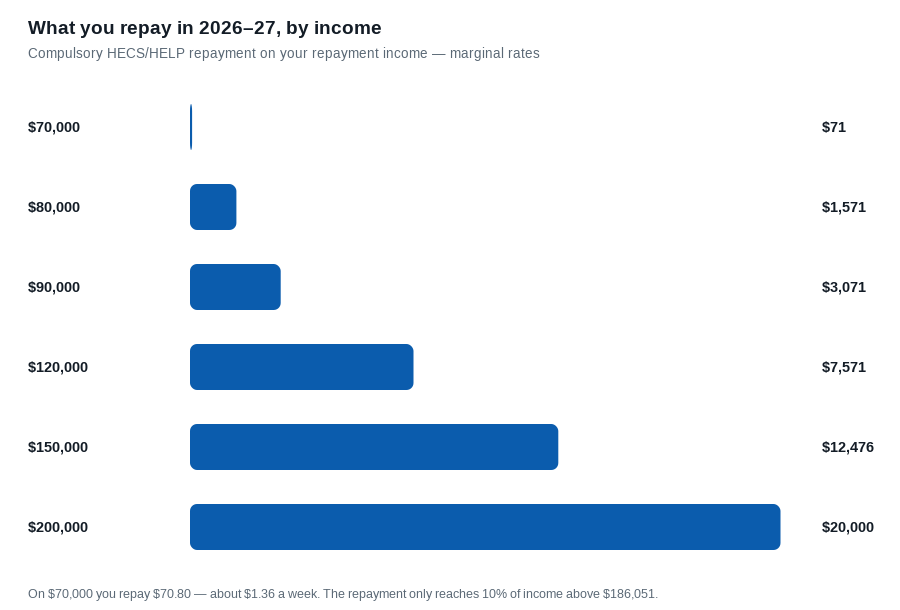
Compulsory repayment rises steadily with income — there is no sudden jump at any threshold.
What counts as repayment income
Your repayment is not based on your taxable income alone. The ATO adds several amounts back to work out your repayment income:
| Included in repayment income | Why it matters |
|---|---|
| Taxable income | Your income after deductions |
| Reportable fringe benefits | Salary packaging benefits count, even if your employer is exempt |
| Total net investment loss | Rental and other investment losses are added back |
| Reportable super contributions | Salary sacrificed into super counts |
| Exempt foreign employment income | Foreign income exempt from Australian tax still counts |
Two consequences catch people out:
- Salary sacrifice does not reduce your HELP repayment. If you sacrifice $10,000 of salary into super, your taxable income falls by $10,000 — but your repayment income does not move, because reportable super contributions are added straight back.
- Negative gearing does not reduce it either. A net rental loss is added back to your repayment income, so a negatively geared property will not bring your repayment down.
The ATO’s own example shows how it adds up: Christina has taxable income of $60,470, reportable fringe benefits of $5,400, a net investment loss of $1,330, reportable super contributions of $16,500 and exempt foreign employment income of $2,680. Her repayment income is $86,380 — well above her taxable income — and her 2026–27 repayment is 15% × ($86,380 − $69,528) = $2,527.80.

Salary sacrifice, fringe benefits and investment losses are added back — so check your repayment income, not just your taxable income.
Old system vs new system: how much less do you pay?
The ATO’s own example makes the difference concrete. Grace has a HELP debt and a repayment income of $80,000 in 2025–26. Under the old system her repayment would have been $2,800. Under the marginal system she pays 15% of the $13,000 above the $67,000 threshold — $1,950, a saving of $850. Her employer withholds less from her pay, so she sees about $32 extra each fortnight.
The same comparison for 2026–27, against the 2024–25 rates:
| Repayment income | Old system (2024–25) | New system (2026–27) | You save |
|---|---|---|---|
| $70,000 | $1,750 (2.5% of total) | $70.80 | $1,679.20 |
| $80,000 | $3,200 (4.0% of total) | $1,570.80 | $1,629.20 |
| $90,000 | $4,500 (5.0% of total) | $3,070.80 | $1,429.20 |
| $100,000 | $5,500 (5.5% of total) | $4,570.80 | $929.20 |
The saving shrinks as income rises, and it disappears at the top: from $186,051 the repayment is 10% of total repayment income under both systems, so there is no change for people earning $179,286 or more (the top of the old 2025–26 scale). Most people’s repayments are lower from their 2026 tax return onwards, and some no longer need to make a repayment at all.
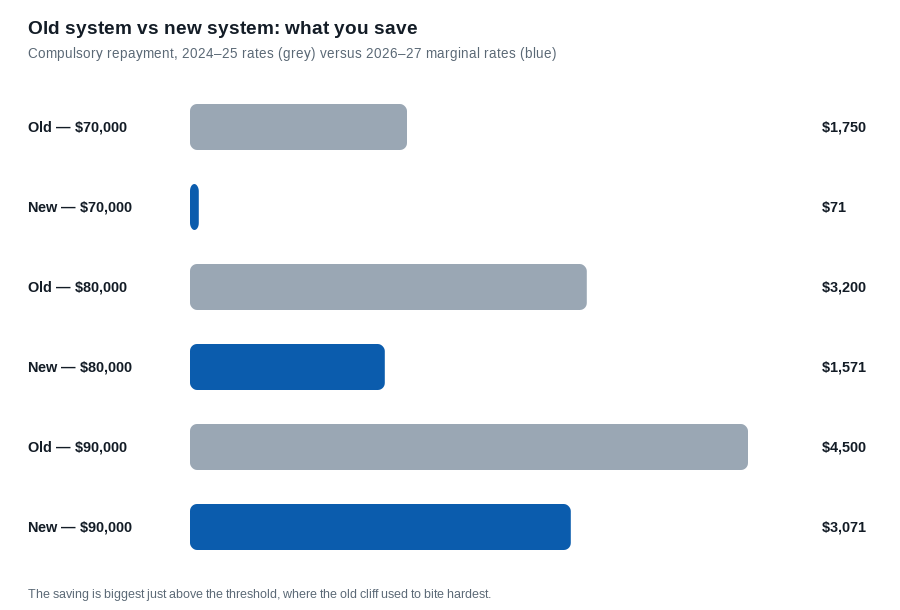
The marginal system helps most at incomes just above the threshold, where the old cliff used to bite hardest.
The 20% debt cut
If you had a study loan balance on 1 June 2025, the ATO has cut it by 20%. The cut was applied to the balance as it stood on 1 June 2025, before that year’s indexation, and the ATO has now completed processing it for all debts. You can see the reduced balance in ATO online services or the ATO app, and refunds were processed where an account ended up in credit.
Worked example: a $30,000 balance
| Step | Balance |
|---|---|
| Balance on 1 June 2025 | $30,000 |
| 20% cut applied | −$6,000 → $24,000 |
| Indexation on 1 June 2025 (3.2%) | +$768 → $24,768 |
| Indexation on 1 June 2026 (2.8%) | +$693.50 → $25,461.50 |
A $30,000 balance is $25,461.50 a year later — $4,538.50 lower, even after two rounds of indexation. There is no further 20% cut: it was a one-off, and only the annual indexation applies from here on.
Indexation: your balance grows each 1 June
A HELP debt charges no interest. Instead, the balance is indexed once a year on 1 June, to keep pace with the lower of the Consumer Price Index (CPI) and the Wage Price Index (WPI). Only the part of your debt that has been unpaid for more than 11 months is indexed.
| 1 June | Indexation rate |
|---|---|
| 2023 | 7.1% originally, later revised to 3.2% |
| 2024 | 4.0% (originally 4.7%) |
| 2025 | 3.2% |
| 2026 | 2.8% |
The 2.8% applied on 1 June 2026 is the lowest since 2021. On a $25,000 balance it added $700. A voluntary repayment made directly to the ATO before 1 June reduces the balance that gets indexed — extra tax withheld from your pay during the year does not, because it only reaches your loan account when your tax return is processed.
Indexation is not interest — but it still grows your balance each year, so paying extra before 1 June is the cheapest time to do it.
How repayments actually happen
You do not send the ATO a separate payment each month. It works like this:
- Tell your employer. Tick the study loan box on your tax file number declaration when you start a job, so your employer knows to withhold extra from your pay using the ATO’s tax tables.
- Your employer withholds. The extra withholding is based on your pay each period, not on your final annual income — so it is an estimate, not the final figure.
- Your tax return settles it. When you lodge, the ATO works out your actual repayment from your repayment income. If too much was withheld, the difference comes back with your refund. If too little was withheld, the shortfall is added to your tax bill.
- Voluntary repayments are optional. You can pay extra towards your loan at any time through ATO online services. There is no penalty for paying it off early, and no discount for doing so either.
If you move overseas, the obligation does not stop: you still have to make repayments if your worldwide income is above the minimum repayment income, and you need to update your contact details with the ATO.
FAQ
Do I have to repay my HELP debt if I earn under $69,528? No. In 2026–27 there is no compulsory repayment at all until your repayment income passes $69,528. You can still make voluntary repayments if you want to.
Does my HELP debt affect my credit score? No — a study loan does not appear on your credit report. But a lender will ask about it when you apply for a home loan, because the compulsory repayment reduces your take-home pay and therefore what you can borrow.
Does salary sacrificing into super reduce my HELP repayment? No. Reportable super contributions are added back when the ATO works out your repayment income, so salary sacrifice leaves your repayment unchanged. It can still be worth doing for the tax saving — just don’t expect it to shrink your HELP repayment.
Should I pay my HELP debt off early? It depends. The debt charges no interest, only indexation at 2.8% in 2026, which is below most mortgage and personal loan rates. Paying extra before 1 June does save you that year’s indexation on the amount you pay. But money used to clear a low-cost HELP debt is money not going to a mortgage, an emergency fund or super — so weigh it against your other debts first.
What happens to my HELP debt if I die? It is written off. A study loan debt does not pass to your estate or your family.
I finished studying years ago — does the 20% cut still apply to me? Yes, if you had a balance on 1 June 2025. The cut applied to all existing study loan balances on that date, regardless of when you studied, and the ATO has completed processing it. Check your balance in ATO online services to see it.
Do I still repay if I go overseas? Yes, if your worldwide income is above the threshold. You need to lodge an overseas travel notification and report your income to the ATO each year.
Sources
Calculate Your Exact Weekly Tax
Enter your pay details and instantly see your PAYG tax, Medicare levy, and take-home pay.
Open the Calculator