
Division 296 Super Tax: The $3 Million Super Tax Explained
By Easha · Tax accountant, Sydney
From 1 July 2026, super balances over $3 million face an extra 15% tax on earnings — and 25% over $10 million. Here's how Division 296 works, what counts as earnings, when you'll pay, and two worked examples.
Key takeaways
- Division 296 is now law. From 1 July 2026, an extra 15% tax applies to the earnings on the part of your super balance above $3 million — and an extra 25% on earnings above $10 million.
- It only applies to realised earnings — dividends, interest, rent and capital gains you actually bank — not to paper gains when your investments rise in value.
- For the first year, 2026–27, what matters is your total super balance on 30 June 2027. From 2027–28, either the start or the end of the year can trigger it.
- Your fund pays its usual 15% tax first. Division 296 is a separate, personal tax on top, and you can generally pay it from your super.
- The first assessments won’t arrive until the later half of 2027–28 — so nothing is due yet, and there is time to check where you stand.
- The ATO has published draft guidance (TR 2026/D3 and LCR 2026/D6) and is taking comments until 18 December 2026.
If you have ever heard super described as a low-tax place to hold your retirement savings, that is still true — but from 1 July 2026 it is a little less true for very large balances. Division 296 is a new tax that trims the tax concessions on super balances above $3 million.
It is not a tax on your balance. It is an extra tax on the earnings your super makes, and only on the slice of those earnings that relates to the part of your balance above the threshold. If your balance is under $3 million, Division 296 does not touch you at all.
This is general information, not tax or financial advice. The rules are set out on the ATO pages linked below — check them, or speak to a registered tax agent, for your own circumstances.

Think of your super balance in slices: only the part above $3 million attracts the extra 15% tax, and only the part above $10 million attracts the extra 25%.
What is Division 296?
Division 296 is the name for the new tax on large super balances, introduced by the Treasury Laws Amendment (Building a Stronger and Fairer Super System) Act 2026 and the Superannuation (Building a Stronger and Fairer Super System) Imposition Act 2026. It passed Parliament in March 2026 and applies from the 2026–27 income year.
The idea is simple: super earnings are normally taxed at 15% inside the fund. For balances above $3 million, the government has decided that concession is too generous, so an extra layer of tax applies to the earnings on the balance above the threshold.
Two thresholds apply in 2026–27:
| Threshold | Amount | Extra tax on earnings above it |
|---|---|---|
| Large super balance threshold (LSBT) | $3 million | 15% |
| Very large super balance threshold (VLSBT) | $10 million | 25% (15% + a further 10%) |
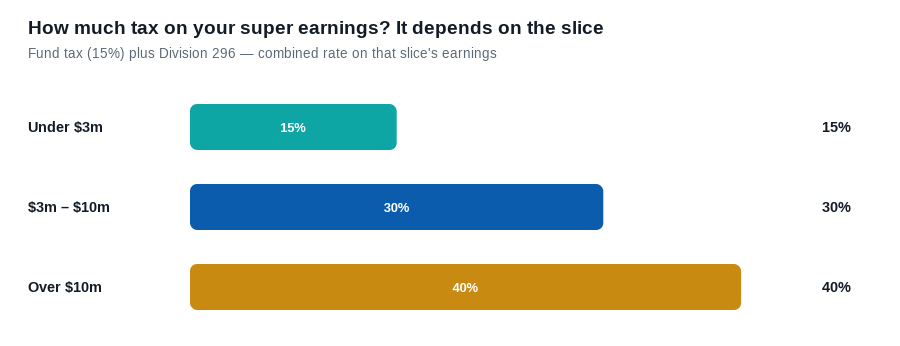
Only the slice above each threshold is taxed at the higher rate — the first $3 million always stays at the standard 15%.
In other words, earnings on the part of your balance between $3 million and $10 million attract 15% Division 296 tax on top of the fund’s 15% — a combined 30% on that slice. Earnings on the part above $10 million attract 25% Division 296 tax on top of the fund’s 15% — a combined 40%.
Both thresholds are indexed to inflation (CPI). The $3 million threshold rises in $150,000 steps and the $10 million threshold in $500,000 steps, so they will creep up over time rather than staying fixed.
How the tax is worked out, step by step
Your fund works out your taxable super earnings for the year, then the ATO applies the thresholds. The calculation runs like this:
- Add up your total super balance (TSB) — everything you hold across all your super funds, including pension accounts. Amounts borrowed under a limited recourse borrowing arrangement are disregarded.
- Check whether you are over the threshold. For 2026–27, only your balance at the end of the year — 30 June 2027 — matters. From 2027–28 onwards, Division 296 applies if your balance is over a threshold either just before the start of the year or at the end of it.
- Work out the proportion of your balance above each threshold. If your balance is $4 million, then $1 million of it — 25% — sits above the $3 million threshold.
- Apply that proportion to your taxable super earnings. Only the earnings relating to the above-threshold part are taxed at the extra rate.
- The ATO issues you a Division 296 notice of assessment. Your fund reports your earnings to the ATO, and the ATO does the maths and sends you the bill.
One important detail: the tax is calculated on realised earnings only — dividends, interest, rent, trust distributions and capital gains you have actually realised, less realised losses. If your shares or property rise in value but you haven’t sold them, that paper gain is not taxed under Division 296. That is a big change from the original proposal, which would have taxed unrealised gains too.
Worked example 1: a $4 million balance
Sarah has a total super balance of $4,000,000 at 30 June 2027. Her fund reports taxable super earnings of $200,000 for 2026–27.
| Step | Calculation | Result |
|---|---|---|
| Balance above $3 million | $4,000,000 − $3,000,000 | $1,000,000 |
| Proportion above $3 million | $1,000,000 ÷ $4,000,000 | 25% |
| Earnings above the threshold | $200,000 × 25% | $50,000 |
| Division 296 tax | 15% × $50,000 | $7,500 |
| Fund tax (already paid) | 15% × $200,000 | $30,000 |
| Total tax on the year’s earnings | $30,000 + $7,500 | $37,500 |
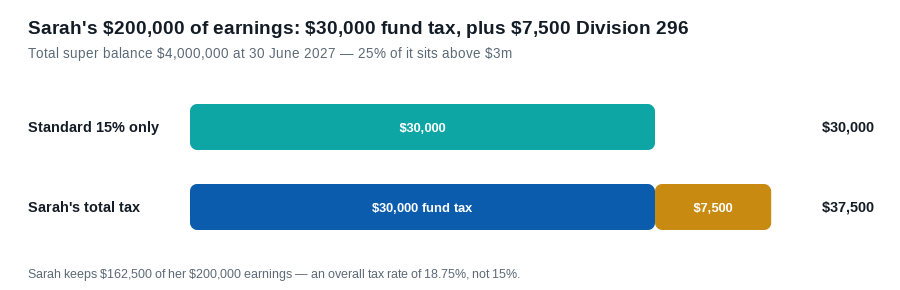
Sarah’s bill: $30,000 of fund tax plus $7,500 of Division 296 — $37,500 in total on $200,000 of earnings.
So on $200,000 of earnings, Sarah pays $37,500 in total tax — an overall rate of 18.75%, instead of the standard 15%.
Worked example 2: an $11 million balance
James has a total super balance of $11,000,000 at 30 June 2027. His fund reports taxable super earnings of $400,000 for 2026–27. Both thresholds bite here.
| Step | Calculation | Result |
|---|---|---|
| Earnings on the $3m–$10m slice | 15% × $400,000 × ($7,000,000 ÷ $11,000,000) | $38,182 |
| Earnings on the above-$10m slice | 25% × $400,000 × ($1,000,000 ÷ $11,000,000) | $9,091 |
| Division 296 tax | $38,182 + $9,091 | $47,273 |
| Fund tax (already paid) | 15% × $400,000 | $60,000 |
| Total tax on the year’s earnings | $60,000 + $47,273 | $107,273 |
On $400,000 of earnings, James pays $107,273 in total tax — an overall rate of about 26.8%.
What counts as earnings — and what doesn’t
Division 296 uses “taxable super earnings”, which is close to the taxable income of the fund, worked out for each member. In practice that means:
- Counted: dividends, interest, rent, trust distributions, and realised capital gains (after realised capital losses).
- Not counted: unrealised gains — your investments going up in value on paper.
- Not counted: contributions. Putting money into super does not create Division 296 earnings, though contributions do increase your balance, which can push you over a threshold.
There is also a CGT adjustment for assets your fund already held at 30 June 2026. Because the tax only starts on 1 July 2026, the fund can elect to adjust the cost base of those assets so that gains built up before the start date are not caught by the new tax.
Who doesn’t have to pay
You are excepted from Division 296 tax if you:
- are a child receiving a super income stream at any time during the income year;
- received a structured settlement contribution for a personal injury, in this year or an earlier year; or
- die during the 2026–27 income year.
There are also specific rules for defined benefit interests, temporary residents who leave Australia, and certain office holders such as judges — the ATO page below has the detail.
If you hold a defined benefit interest and have not yet taken an end benefit, any Division 296 tax relating to that interest is deferred until a later date, and you can choose to pay it early voluntarily to avoid interest.
Nothing is due yet — the first bills arrive in the later half of 2027–28, and you get 84 days to pay once your assessment lands.
When do you actually pay?
Nothing is due yet. The timeline looks like this:
| When | What happens |
|---|---|
| 1 July 2026 | Division 296 starts. The 2026–27 year is the first year it applies. |
| During 2026–27 | Your fund tracks your earnings and your balance. |
| 30 June 2027 | First measurement date — your balance on this day decides whether Division 296 applies for 2026–27. |
| Later half of 2027–28 | The ATO starts issuing Division 296 assessments for 2026–27. |
| 84 days after your assessment | Your Division 296 tax is due and payable. |
| Within 60 days of your assessment | You can elect to have the money released from your super fund to pay the bill. |
If you don’t pay on time and don’t elect a release from your super, the Commissioner can ask one of your funds to release the amount on your behalf. Interest applies to late payment, so the release election is worth using if you don’t want to pay from outside super.
If you lodge through myTax, your Division 296 notice of assessment will land in your myGov inbox. If you use a tax agent, ask them to check your communication preferences so the notice goes to the right place.
The draft guidance — and your chance to comment
The ATO published draft guidance on 4 November 2026: draft Taxation Ruling TR 2026/D3 and draft Law Companion Ruling LCR 2026/D6. Comments close on 18 December 2026. The drafts cover how the tax is calculated, including the CGT adjustment and the treatment of defined benefit interests. If you are affected, or advise people who are, that consultation window is the time to raise practical problems with the ATO.
What to do if you are near $3 million
- Check your total balance, not just one fund. Division 296 looks at everything you hold across all funds, including pension accounts. Log in to myGov and check your total super balance.
- Remember the first measurement date is 30 June 2027. For 2026–27, only your balance on that day matters — but from 2027–28, your balance at the start of the year counts too.
- Don’t rush to withdraw money. Taking money out of super to get under $3 million has its own rules and consequences, including preservation and tax on withdrawals. Get advice before moving large amounts.
- Keep an eye on the draft guidance. The ATO’s rulings will settle the practical details, and the consultation closes on 18 December 2026.
- Talk to your fund. Your fund will report your earnings to the ATO — make sure it has your correct details and that you know how it will calculate your share.
FAQs about Division 296
Does Division 296 apply if my balance is under $3 million?
No. If your total super balance is $3 million or less, Division 296 does not apply to you at all.
Is it a tax on my super balance?
No — it is a tax on the earnings on the part of your balance above the threshold. A $4 million balance with no earnings in a year would generate no Division 296 tax for that year.
Does it tax unrealised gains?
No. Only realised earnings count — dividends, interest, rent and gains you have actually realised. Paper gains are not taxed.
Can I pay it from my super?
Yes. You can elect within 60 days of your assessment to release money from one or more of your super funds to pay it. If you don’t pay and don’t elect a release, the ATO can ask a fund to release the amount.
When will I get my first bill?
Assessments for the 2026–27 year will begin issuing in the later half of the 2027–28 income year. The tax is then due 84 days after the assessment issues.
What if my balance drops below $3 million later?
From 2027–28, Division 296 applies if your balance is over a threshold either just before the start of the year or at the end of it — so a balance that was over at the start of the year can still trigger the tax even if it falls below the threshold by year end. For the first year, 2026–27, only the 30 June 2027 balance matters.
Does Division 296 affect the $1.9 million transfer balance cap?
No. The transfer balance cap is a separate limit on how much you can move into a retirement phase pension. Division 296 is a tax on earnings above $3 million — it does not change the cap.
This post is general information, not tax or financial advice. Figures are from the ATO as at 21 November 2026, for the 2026–27 income year unless stated otherwise. Check the ATO pages below or speak to a registered tax agent for your own circumstances.
Sources: ATO, Division 296 tax on large super balances; ATO, About Division 296 tax for APRA funds; Treasury Laws Amendment (Building a Stronger and Fairer Super System) Act 2026.
Want to check your own pay and tax? Use our free Weekly Tax Calculator or browse the Tax Blog.
Calculate Your Exact Weekly Tax
Enter your pay details and instantly see your PAYG tax, Medicare levy, and take-home pay.
Open the Calculator