
Capital Gains Tax Changes 2027: What Changes on 1 July 2027
By Easha · Tax accountant, Sydney
From 1 July 2027 the 50% CGT discount is replaced by cost base indexation, with a 30% minimum tax on gains accruing after that date. Here's what changes, what stays the same, and what to do before the cut-off — in plain English.
Key takeaways
- From 1 July 2027, the 50% CGT discount is replaced by cost base indexation for resident individuals, trusts and partnerships. You will be taxed on the real gain above inflation, not on half the total gain.
- A minimum 30% tax will apply to certain net capital gains accruing on or after 1 July 2027. If your marginal rate is lower, the tax on that gain is topped up to 30%.
- Gains built up before 1 July 2027 keep the old rules. For an asset you already own, the gain is split at 1 July 2027 — the earlier part keeps the 50% discount, the later part uses the new rules.
- Your home stays exempt. The main residence exemption is not changing.
- Nothing changes on your 2025-26 tax return. The 2027-28 return is the first one that could be affected, and only if you sell something in that year.
If you own shares, an investment property or another asset you might one day sell, you have probably heard the same headline a few times now: the capital gains tax discount is going away.
It is true — but it is not happening tomorrow, and it does not wipe out everything you have built up so far. The change is already law, it starts on 1 July 2027, and the part that matters most for most people is the date in the middle: gains made before 1 July 2027 keep today’s treatment.
This is general information, not tax advice. The reform is detailed, and some of the finer guidance is still being finalised, so check the ATO pages linked below or speak to a registered tax agent before you buy or sell because of it.
What is changing, in one paragraph
On 12 May 2026, in the federal Budget 2026-27, the Government announced it would reform CGT. The first stage is now law under the Treasury Laws Amendment (Tax Reform No. 1) Act 2026, which received Royal Assent on 26 June 2026.
From 1 July 2027, for resident individuals, trusts and partnerships:
- the 50% CGT discount is replaced by cost base indexation on gains accruing on or after that date
- a minimum 30% tax applies to certain net capital gains accruing on or after that date
- pre-CGT assets — assets acquired before 20 September 1985 — become subject to CGT for gains accruing on or after that date
The ATO is clear on the timing: these changes do not apply to the 2025-26 tax return, and the 2027-28 return will be the first that could be affected.
The old rule: the 50% discount
Today, if you are an Australian resident for tax purposes and you have owned an asset for at least 12 months, you can reduce the capital gain by 50%.
You work out the gain first — sale price less cost base, less capital losses — then you halve what is left. That halved amount is added to your taxable income and taxed at your marginal rate. CGT is not a separate tax.
So a $60,000 gain on shares held for two years becomes a $30,000 net capital gain. At a 30% marginal rate, that is $9,000 of tax. At a 15% marginal rate, it is $4,500.
That is the rule most investors have planned around for more than 25 years. From 1 July 2027, for gains accruing after that date, it is gone.
The new rule: cost base indexation
Cost base indexation is an older idea, brought back. Instead of halving the gain, you adjust your purchase price for inflation using the Consumer Price Index (CPI) before you calculate the gain.
In plain English: you are taxed on the real gain — the growth above inflation — rather than on half of the total gain.
Say you bought shares for $50,000 and sold them for $80,000. Under the old rule, the $30,000 gain is halved to $15,000. Under indexation, if CPI rose 9% while you held them, your cost base becomes $54,500 ($50,000 × 1.09), and your taxable gain is $25,500 ($80,000 − $54,500).
Whether that leaves you better or worse off depends on how long you held the asset and how much of the gain was just inflation. A short hold with fast price growth will usually pay more under the new rules. A very long hold, where inflation did most of the work, can pay less — because only the gain above inflation is taxed at all.
You still need to have owned the asset for at least 12 months to qualify for indexation, just as you did for the discount. Count the 12 months excluding the acquisition day and the CGT-event day. For property, the CGT event is the contract date, not settlement. For shares, it is the trade date.
The 30% minimum tax
This is the part that catches low-income sellers by surprise.
From 1 July 2027, a minimum 30% tax will apply to certain net capital gains accruing on or after that date. If the tax on your gain at your normal marginal rates is less than 30% of the gain, you pay a top-up to bring it to 30%.
Using the example above: the indexed gain is $25,500. At a 30% marginal rate, the tax is $7,650 — no top-up needed. At a 15% marginal rate, the ordinary tax would be $3,825, so a top-up of $3,825 applies and the total is still $7,650.
In other words, after 1 July 2027, a retiree or part-time worker in a low bracket no longer gets the double benefit of a halved gain taxed at a low rate. The gain is taxed at 30% at a minimum, before offsets and excluding the Medicare levy.
There are limited exceptions. The ATO says some exemptions will apply, and Budget and adviser summaries of the reform report that people receiving a means-tested income-support payment — such as the Age Pension — in the year they realise the gain are exempt from the 30% minimum, with the gain then taxed at their marginal rate. That exception is not spelled out in detail on the ATO reform page itself, so treat it as a point to confirm on the ATO or Treasury explainer before you rely on it. It matters a lot for pensioners: it is the difference between the minimum applying and not applying.
For more on how a gain interacts with the pension, see our guide to Australia capital gains tax and the pension.
What is not changing
Three things stay exactly as they are, according to the ATO:
- the meaning of a CGT asset
- the framework of a CGT event
- the main residence exemption
Your own home is not caught by this reform. If your home qualifies for the full main residence exemption today, it still will after 1 July 2027. That is worth saying plainly, because it is the first thing most people worry about — and it is unchanged.
Companies never received the 50% discount, so this change is aimed at individuals, trusts and partnerships.
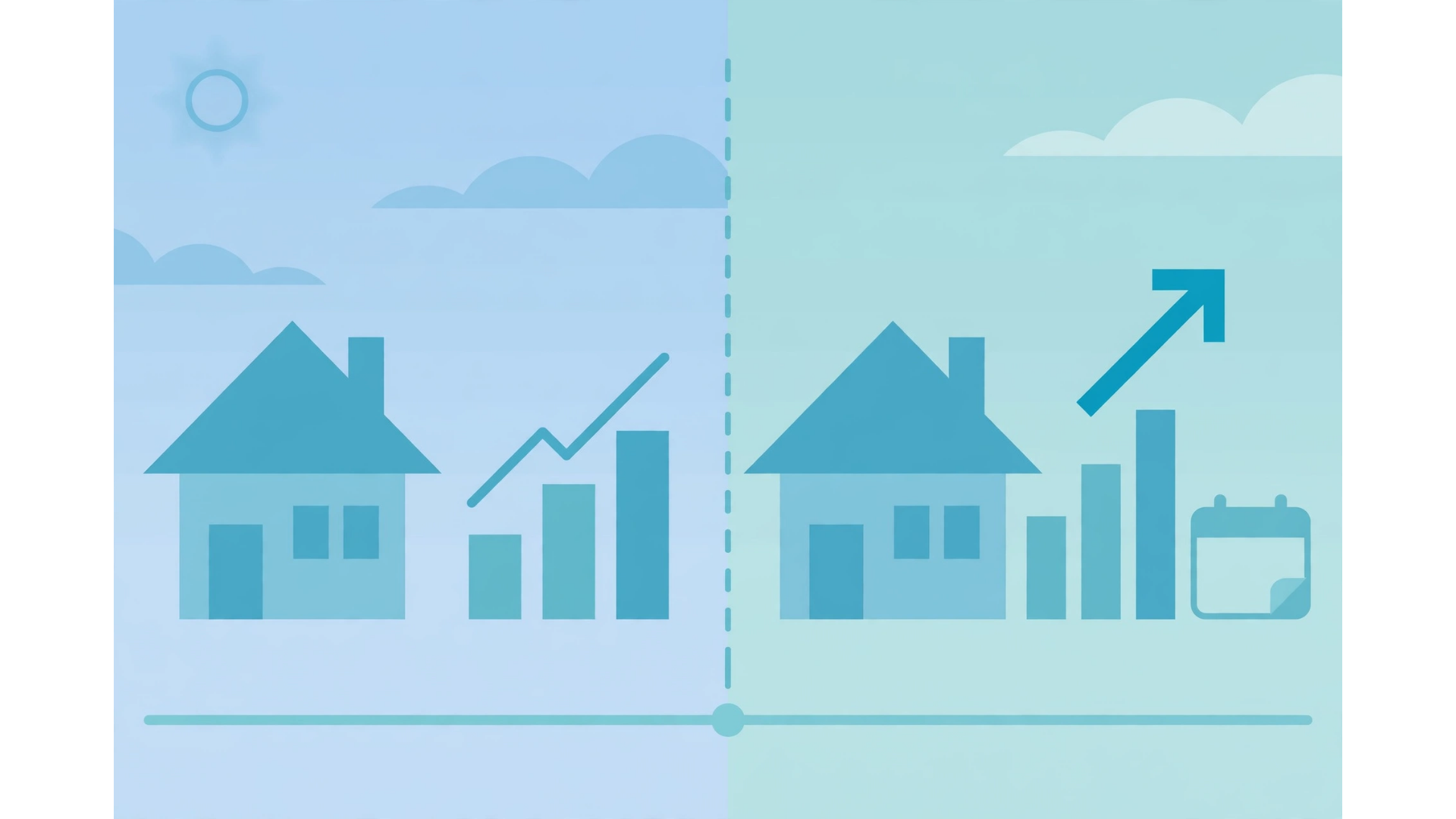
Gains are split at 1 July 2027 — the part built up before that date keeps the old treatment, the part after it uses the new rules.
The transitional rules: gains are split at 1 July 2027
This is the most important section if you already own something. The law does not pretend you bought everything again on 1 July 2027 and tax the whole gain under the new rules. It splits the gain in two.
- Assets bought and sold before 1 July 2027: no change. The old rules apply in full.
- Assets bought on or after 1 July 2027: the new rules apply in full.
- Assets owned before 1 July 2027 and sold on or after that date: the gain up to 1 July 2027 is treated under the current arrangements, and the gain after that date is treated under the new arrangements.
The ATO describes it as if you disposed of the asset immediately before 1 July 2027 and reacquired it on 1 July 2027. The asset’s value immediately before 1 July 2027 becomes the cost base for the post-1 July 2027 gain, and the 50% discount applies to the difference between the original cost base and that 1 July 2027 value.
Any gain or loss from that split is deferred — you only report it when you later sell the asset or another CGT event happens.
Worked example: an investment property you already own
These are simple, illustrative numbers, before buying and selling costs, offsets and Medicare.
You bought an investment property for $600,000. Immediately before 1 July 2027 it is worth $900,000. You later sell it for $1,000,000.
- Pre-1 July 2027 gain: $900,000 − $600,000 = $300,000. The 50% discount applies, so $150,000 of that part is taxable.
- Post-1 July 2027 gain: $1,000,000 − $900,000 = $100,000. Say CPI rises 3% after 1 July 2027, so the indexed cost base is $927,000 ($900,000 × 1.03). The real gain is $73,000 ($1,000,000 − $927,000), taxed at a minimum of 30%.
- Total taxable gain: $150,000 + $73,000 = $223,000.
Under the old rules for the whole period, the $400,000 total gain would have been halved to $200,000. So in this example the new rules produce a larger taxable gain — $223,000 instead of $200,000 — even though indexation shrank the post-2027 part from $100,000 to $73,000. The 50% discount was worth more than indexation on the earlier, larger gain, and that earlier gain keeps its discount either way.
The lesson is not that every sale will cost more. It is that the answer depends on when the growth happened, how long you hold after 1 July 2027, and what inflation does in between. A property that grows slowly after 2027, mostly with inflation, will look very different from one that jumps quickly.
Worked example: shares bought after 1 July 2027
You buy shares for $50,000 after 1 July 2027 and sell them for $80,000 three years later. CPI rose 9% over that time.
- Indexed cost base: $50,000 × 1.09 = $54,500.
- Real gain: $80,000 − $54,500 = $25,500.
- Tax at a 30% marginal rate: $7,650. At a 15% marginal rate, the 30% minimum tops the tax up to $7,650 as well, subject to any exception that applies to you.
Under the old rules, the same sale would have produced a $15,000 net gain after the discount — $4,500 of tax at 30%, or $2,250 at 15%. That is why the reform matters most for people who sell in a low-income year: the discount used to do a lot of the work, and indexation plus the minimum do much less of it.
Pre-CGT assets: the exemption ends for future gains
Assets acquired before 20 September 1985 have been exempt from CGT. That exemption continues for gains accrued before 1 July 2027. For gains accruing on or after 1 July 2027, those assets become subject to CGT, with cost base indexation available to calculate the gain.
If you hold a pre-CGT asset, the value immediately before 1 July 2027 is the key number — it separates the exempt past from the taxable future. Keep the records that support it.
New builds and affordable housing: you can keep the discount
There is one deliberate carve-out. You can choose to continue applying the current arrangements and the 50% CGT discount for assets owned on, or purchased on or after, 1 July 2027 that are either:
- new residential dwellings, or
- used to provide affordable housing.
This is the same policy thread as the negative gearing change in the same Act: from 1 July 2027, negative gearing on residential property is limited to new builds, with properties bought after 7:30pm AEST on 12 May 2026 caught and earlier holdings grandfathered. New builds keep both concessions. We will cover that change in detail in a separate post — for now, the point is that a new build is treated differently from an established home under both measures.
One caution: the detailed definition of a new residential dwelling is being settled in separate legislation — the Treasury Laws Amendment (Tax Reform No. 3) Bill 2026, released as an exposure draft in August 2026 and introduced to Parliament in October 2026. Do not rely on a marketing label of “new” until that definition is law.
Do you need a valuation on 1 July 2027?
Probably not yet — and not in advance.
The ATO says you generally do not need to know the market value of your asset immediately before 1 July 2027 to complete your 2026-27 tax return. When you sell, or another CGT event happens, you will need to establish what that market value was. The earliest you would include a gain calculated this way is generally in your 2027-28 return, lodged on or after 1 July 2028, and only if you sell in that year.
The ATO also says it will provide further guidance before the start date on how to work out market value for different assets, which professionals to engage, and what records to keep. There is also an alternative to a valuation — the apportionment method — but the Government is still developing it, and the ATO says it will provide guidance once it has been enacted. Do not pay for a forward-looking valuation now on the strength of a headline; keep your purchase records, improvement receipts and any existing valuations, and wait for that guidance.
What you should do now is much simpler: make sure you can prove when you bought each asset, what you paid, what you have spent on it since, and whether it was ever your main residence or used to produce income. Those records decide how much of a future gain is pre-2027 and how much is post-2027.
What to do before 1 July 2027
- Do not sell just to beat the date. Selling before 1 July 2027 locks in the discount on the whole gain, but it also means paying tax now, paying selling costs now, and giving up future growth. For many people that is a worse deal than holding.
- Do not assume you are worse off. If you hold for a long time after 2027 and most of the growth is inflation, indexation can be kinder than the discount. Run both numbers for your own asset and your own marginal rate.
- Check your low-income years. If you expect a low-income year after 2027 — retirement, a career break, a year between jobs — remember the 30% minimum may apply to the gain, unless an income-support exception applies to you. The timing of a sale matters more than it used to.
- If you own a pre-CGT asset, get your records in order. The 1 July 2027 value is the line between exempt and taxable growth.
- If you are buying an investment property, understand the new-build distinction. It affects both CGT and negative gearing from 1 July 2027, and the definition is still being finalised.
- Keep the 2027-28 return in mind, not the 2025-26 one. Nothing in this reform changes the return you are about to lodge. The first return it can touch is 2027-28.
FAQs about the CGT changes 2027
Is the 50% CGT discount being removed?
Yes, for gains accruing on or after 1 July 2027, for resident individuals, trusts and partnerships. It is replaced by cost base indexation. Gains accruing before 1 July 2027 keep the discount, and you can choose to keep the discount for new residential dwellings and affordable housing.
When do the CGT changes start?
1 July 2027. The law — the Treasury Laws Amendment (Tax Reform No. 1) Act 2026 — was passed in June 2026, but the changes do not apply to the 2025-26 tax return. The 2027-28 return is the first that could be affected.
Will I pay 30% tax on my whole capital gain?
No — the 30% minimum applies to certain net capital gains accruing on or after 1 July 2027, after indexation. If your marginal rate is already 30% or higher, you pay your marginal rate. If it is lower, the tax on that gain is topped up to 30%, subject to limited exceptions.
Does the change affect my family home?
No. The main residence exemption is not changing.
Do I need a valuation of my property on 1 July 2027?
Not now, and not before that date. You will need to establish the market value immediately before 1 July 2027 when you later sell, and the ATO says it will issue guidance on how to do that before the start date. Keep your purchase and improvement records in the meantime.
What happens to assets I bought before 20 September 1985?
Gains accrued before 1 July 2027 stay exempt. Gains accruing on or after 1 July 2027 become subject to CGT, calculated with cost base indexation.
This post is general information, not tax advice. Figures are from the ATO and Treasury as at 18 November 2026, for the 2026-27 and 2027-28 years unless stated otherwise. The worked examples use hypothetical CPI figures to show how indexation works — your actual CPI adjustment will depend on the CPI at the time you sell. The apportionment method and the detailed new-build definition were still being finalised at the time of writing. Check the ATO and Treasury for your own circumstances, or speak to a registered tax agent.
Sources: ATO, Capital gains tax reform, published 13 October 2026; Treasury, Second reading speech, Treasury Laws Amendment (Tax Reform No. 1) Bill 2026.
Want to check your own pay and tax? Use our free Weekly Tax Calculator or browse the Tax Blog.
Calculate Your Exact Weekly Tax
Enter your pay details and instantly see your PAYG tax, Medicare levy, and take-home pay.
Open the Calculator