
Australia Capital Gains Tax Pension Exemption
By Easha · Tax accountant, Sydney
There is no general CGT exemption for pensioners in Australia. Here's what actually protects retirees — the main residence exemption, the 50% discount, the small business retirement exemption and tax-free super in retirement phase — and how a capital gain can affect your Age Pension.
Key takeaways
- There is no general CGT exemption for pensioners or Age Pension recipients. Being retired does not switch CGT off.
- Your main residence is usually exempt, and assets held for 12 months or more get a 50% CGT discount.
- A capital gain is not counted separately as income for the Age Pension, but the sale proceeds count under the assets test and can reduce or stop your pension.
- Small business owners can disregard up to $500,000 of gains over a lifetime under the retirement exemption.
- From 1 July 2027, the 50% discount will be replaced by cost base indexation for gains accruing after that date. The main residence exemption is not changing.
If you are on the Age Pension, or about to retire, and you are thinking about selling shares, an investment property or a small business, the question comes up fast: do pensioners pay capital gains tax?
The short answer is yes, they can — but most retirees do not pay CGT on the sale that matters most to them, their home. The protection comes from the asset and how it was used, not from your pension status.
This is general information, not tax advice. CGT is an area where the details matter, so check the ATO pages linked below or speak to a registered tax agent before you sell.
Is there a CGT exemption for pensioners?
No. The ATO’s list of CGT exemptions contains no pensioner or Age Pension category. Exempt assets are things like assets acquired before 20 September 1985, your main residence, cars and motorcycles, and specific payouts — not a status-based exemption for retirees.
The ATO puts it plainly in its community answers: “CGT requirements aren’t altered by retirement.” If you sell an investment property, CGT still applies unless you meet one of the listed exemptions, for example the main residence exemption or the pre-CGT rule.
What does change with age is the tax calculation around the gain, not whether CGT applies. The Age Pension itself is taxable income and must be included in a tax return. The Seniors and Pensioners Tax Offset, known as SAPTO, can reduce the tax on a modest gain to nil for low-income retirees — but SAPTO is an offset, not a CGT exemption.
For 2025-26, the maximum SAPTO for a single person is $2,230, shading out from $34,919 and cutting out at $52,759 of rebate income. For 2026-27, those thresholds are $36,034 and $53,874. You do not need to actually receive the Age Pension to qualify for SAPTO — you qualify if you are Age Pension age, currently 67, and eligible for the Age Pension, even if you did not claim it or failed the income or assets test.

For most pensioners, the home is the exemption that matters — sell it as your main residence and the gain is usually tax-free.
Your home: the main residence exemption
For most pensioners, this is the exemption that matters.
Your main residence is generally exempt from CGT if you are an Australian resident and the dwelling has been your home for the whole period you owned it, has not been used to produce income, and is on land of 2 hectares or less. If all of those conditions are met, you pay no tax on any gain and ignore any loss. If not, you may still get a partial exemption.
You can only have one main residence at a time, except you can treat both your old and new homes as your main residence for up to 6 months when you move.
The 6-year rule
Once you stop living in your home, you can continue treating it as your main residence for CGT purposes:
- Up to 6 years if you rent it out — the 6-year rule
- Indefinitely if you do not use it to produce income — for example, you leave it vacant
While you do this, it stays CGT-exempt as if you still lived there, but you cannot treat any other property as your main residence at the same time, except for up to 6 months when moving house. The property must have been your main residence first.
The 6 years applies separately to each absence. Moving back in, or leaving it vacant, stops the clock, and a later absence gets a fresh 6 years.
If you rent it for more than 6 years in one absence, CGT applies to the period after the limit. Your cost base becomes the market value when you first used it to produce income, plus allowable costs since then, and the gain is apportioned by days over the limit.
The ATO gives an example, Roya: she bought an apartment for $180,000, lived in it, moved interstate and rented it when it was worth $220,000, then sold it for $555,000 with $15,000 in agent and solicitor costs. The gain was $320,000. After apportioning for the days it was not her main residence, the assessable gain was $243,162. After the 50% discount, the net capital gain to report was $121,581.
Moving into aged care
Moving into aged care does not itself end the CGT exemption. The CGT clock and the Age Pension clock are different, and it is easy to mix them up.
For CGT, you can rent your former home for up to 6 years and it can still be fully exempt on sale. Leave it vacant and the exemption can continue indefinitely, provided you do not claim another main residence.
For the Age Pension, if you leave your principal home to enter care, Services Australia may exempt the home from the assets test for 2 years from the date you enter care. After 2 years it is assessed as an asset and you are assessed as a non-homeowner — unless your partner is still living there, in which case it stays exempt while they live there. Rent from the former home counts as income under the income test.
Inherited property
There is no CGT at the time you inherit a property. CGT applies when you later sell it, unless an exemption applies.
You can get a full exemption if you dispose of it within 2 years of the deceased’s death, with settlement within 2 years, and either the deceased acquired it before 20 September 1985, or it was the deceased’s main residence just before death and was not being used to produce income. It does not matter if you used it as your main residence or rented it out during those 2 years.
There is also a full exemption if, from the death until disposal, the property was not used to produce income and was the main residence of the deceased’s spouse, a person with a right to occupy under the will, or you as beneficiary.
If disposal is delayed by exceptional circumstances outside your control, the ATO’s Practical Compliance Guideline PCG 2019/5 gives an automatic extension of up to 18 months if all five conditions in the guideline are met. Otherwise you can request a discretionary extension.
An inherited property that was not the deceased’s main residence — for example, a rented investment property — does not get the 2-year full exemption.
The 50% CGT discount
If you owned an asset for at least 12 months and you are an Australian resident for tax purposes, you can reduce the capital gain by 50%.
Count the 12 months excluding the acquisition day and the CGT-event day. For property, the CGT event is the contract date, not settlement. For shares it is the trade date.
Capital losses must be subtracted from gains before the discount is applied. Trusts also get 50%. Complying super funds get 33.33%. Companies get no discount.
The discounted gain is added to your assessable income for the year and taxed at your marginal rate. CGT is not a separate tax.

A capital gain is not counted separately as income for the Age Pension — but the sale proceeds count in full under the assets test.
How a capital gain affects your Age Pension
This is where most people get confused, because the ATO and Services Australia treat a gain differently.
Services Australia runs two means tests and pays the lower result: an income test and an assets test.
The income test: the gain is not counted separately
Financial assets — savings, term deposits, managed investments, listed shares and some income streams — are assessed by deeming. Services Australia assumes they earn a set rate, no matter what they really earn. If your investment return exceeds the deemed rates, the extra amount does not count as your income.
From 20 September 2026, the deeming rates are 1.75% on the first $66,800 for a single person, or $110,600 for a pensioner couple combined, and 3.75% above that.
So selling shares at a profit and holding the cash barely moves the income test. Both the shares and the cash are financial assets, deemed on their total value. The gain is not added on top of deemed income.
The income-test free area is $226 a fortnight for a single person, with the pension reducing by 50 cents for each $1 over that.
Real estate is different. An investment property is assessed at market value under the assets test, and net rent counts as actual income under the income test. Selling it converts a non-deemed asset into cash, so the proceeds become deemed income from settlement, rent stops, and the proceeds count in full under the assets test. That is the main way a property sale can reduce the pension.
The assets test: this is where a gain usually bites
The principal home is the only real estate excluded. Everything else — investment property, shares, cash, super once you reach Age Pension age, cars and contents — counts at market value, less any mortgage on that asset.
From 20 September 2026, the full-pension limits are $333,000 for a single homeowner and $499,000 for a couple combined who own their home. The part-pension cut-offs are $745,750 for a single homeowner and $1,121,000 for a couple combined who own their home.
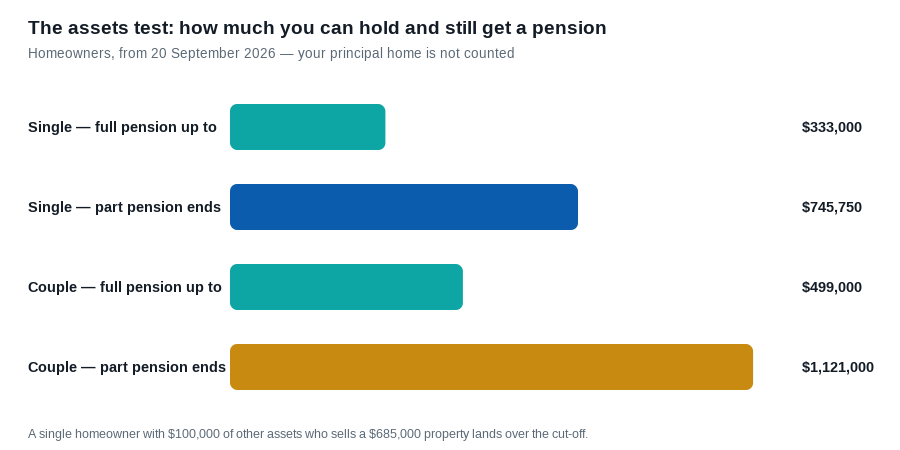
The assets test is where a gain usually bites — once your assessable assets pass the part-pension cut-off, the pension stops.
If you sell your principal home and intend to use the proceeds to buy, build, rebuild, repair or renovate a new principal home, for sales from 1 January 2023 the intended portion is assets-test exempt for up to 24 months from settlement, with a possible further 12 months, to a maximum of 36 months. Only the portion intended for the new home is exempt. Surplus proceeds are assessable from settlement. Tell Services Australia within 14 days.
A one-off gain can reduce or stop your pension, usually through the assets test, not because the gain is counted as income. A gain that is spent, or sheltered in that 24-month home-sale exemption, has a different effect from the same gain left sitting in a bank account.
A gain can also cost you a Commonwealth Seniors Health Card, even when it does not touch the Age Pension, because the card uses adjusted taxable income, which does include the discounted capital gain. Check the current card income limits on the Services Australia site before you sell, as the published limits change with indexation.
Small business CGT retirement exemption
If you sell a small business asset, there are four Division 152 concessions, applied in this order: the 15-year exemption, the 50% active asset reduction, the retirement exemption, and roll-over.
To use any of them you must first meet the basic conditions: either aggregated turnover of less than $2 million, or maximum net assets of $6 million or less, plus the active asset test. The asset must have been active for at least half the ownership period, or at least 7.5 years if owned for more than 15 years.
The retirement exemption lets you disregard capital gains from active assets up to a lifetime limit of $500,000 per individual. The limit is cumulative across all years and all businesses, and it is not indexed. Once you have used $500,000, no further retirement exemption is available. Keep a written record of the amount disregarded.
You do not need to retire to use it, despite the name.
If you are under 55, the exempt amount must be paid into a complying superannuation fund or retirement savings account. If you are 55 or older, there is no requirement to pay any amount to super — you can keep the money.
The other two concessions work like this:
- 15-year exemption: the entire gain is disregarded, if you continuously owned the active asset for at least 15 years and you are 55 or older and disposing of it in connection with retirement, or you are permanently incapacitated. Check this first — it is the most powerful.
- 50% active asset reduction: the remaining gain is halved, if you meet only the basic conditions. It can stack after the general 50% discount.
The ATO gives an example, Harry: he retired from farming and gifted the farm, market value $1,000,000, cost base $600,000. The gain was $400,000. After the 50% discount it was $200,000. After the 50% active asset reduction it was $100,000. The retirement exemption could disregard the full remaining $100,000, leaving $0 taxable gain, if all conditions were met. If Harry had been under 55, that $100,000 would have had to be contributed to a complying super fund.
Amounts contributed to super under the 15-year or retirement exemption are excluded from the non-concessional contributions cap up to the lifetime CGT cap. Check the current CGT cap on the ATO’s key superannuation rates and thresholds page before you rely on a figure.
Super in retirement phase: tax-free earnings, up to a cap
In accumulation phase, investment earnings in a super fund are taxed at 15%. Capital gains on assets held for more than 12 months get the fund’s 33.33% discount, giving an effective 10% tax rate on those gains.
In retirement phase, earnings on assets supporting a retirement-phase income stream are tax-free, subject to the transfer balance cap. That includes rent, interest, dividends and realised capital gains.
Retirement does not flip the switch automatically. You must commence a retirement-phase income stream, such as an account-based pension, and meet a condition of release. Money left in accumulation stays taxed at 15%. A transition-to-retirement pension that is not yet in retirement phase still has its earnings taxed at 15%.
For self-managed super funds, this tax-free treatment is called exempt current pension income, or ECPI. There are two methods: segregated, where specific assets are documented as supporting retirement-phase pensions and all income from those assets is exempt, and proportionate, where an actuary certifies the exempt proportion each year.
The transfer balance cap is a lifetime, per-person limit on how much super can be transferred into tax-free retirement-phase accounts. The general cap is $2.0 million in 2025-26 and $2.1 million from 1 July 2026. Your personal cap is the general cap on the day you first start a retirement-phase income stream, with only proportional indexation on the unused portion after that. Check your personal cap in ATO online services.
Downsizing: selling the home and putting money into super
Selling the family home is usually CGT-free because of the main residence exemption, not because of the downsizer rule. The downsizer rule is about getting money into super, not about avoiding CGT.
A downsizer contribution is a separate, once-in-a-lifetime contribution of up to $300,000 per person, or $600,000 per couple, outside the concessional and non-concessional caps. You must be 55 or older, the home must have been owned by you or your spouse for 10 years or more, and the sale must qualify for the main residence exemption. The contribution must be made within 90 days of receiving the proceeds, and you must give your fund the Downsizer contribution into super form, NAT 75073, before or at the time of contribution.
It does count toward your total super balance and toward the transfer balance cap afterwards. And it can affect your Age Pension: moving money from an exempt home into super makes it an assessable financial asset for the assets test and deeming. The 24-month home-sale exemption covers only money earmarked for a new home, and it ends once the money goes into super. The ATO warns that selling your home and making a downsizer contribution may affect income support payments such as the Age Pension.
Worked examples
These are simple, illustrative numbers, before offsets and Medicare. SAPTO, the Low Income Tax Offset and the 2% Medicare levy are not included in the gross-tax figures below — in real life they can reduce the bill substantially, or to nil for low incomes.
Rates used are the 2025-26 resident rates, unless stated otherwise.
Example A: pensioner sells shares held over 12 months
Bought shares for $20,000. Sold for $50,000.
Capital gain = $50,000 − $20,000 = $30,000. Held for more than 12 months, so the 50% discount applies. Net capital gain = $15,000, added to taxable income.
If other taxable income that year is $25,000, taxable income becomes $40,000.
Gross tax on $40,000 in 2025-26 is ($40,000 − $18,200) × 16% = $3,488. Without the gain, tax on $25,000 would be $1,088. Extra tax attributable to the gain = $2,400, before SAPTO, LITO and Medicare.
If the shares had been held for under 12 months, the full $30,000 would be added instead.
For the Age Pension, the $50,000 cash is a financial asset, deemed like the shares were. The $30,000 gain is not separately added as income. The pension effect comes only if the proceeds push total assessable assets over the full-pension limit.
Example B: pensioner sells an investment property held over 12 months
Bought for $400,000 plus $20,000 buying costs, so the cost base is $420,000. Sold for $700,000 less $15,000 selling costs, so the proceeds are $685,000.
Capital gain = $685,000 − $420,000 = $265,000. After the 50% discount, the net capital gain is $132,500.
If other taxable income is $30,000, taxable income becomes $162,500. Gross tax on $162,500 in 2025-26 is $41,463. Without the gain, tax on $30,000 would be $1,888. Extra tax attributable to the gain = $39,575, before offsets and Medicare. SAPTO is nil here, because rebate income of $162,500 is well above the single cut-out.
For the Age Pension, the effect can be larger than the tax bill. While owned, the property counted in the assets test at market value and net rent counted as income. After sale, the cash counts in the assets test and is deemed. A single homeowner with, say, $100,000 of other assessable assets would go from $785,000 in total assets to over the $745,750 part-pension cut-off, and the pension would stop on the assets test. Individual circumstances vary — use a calculator or speak to a Services Australia Financial Information Service officer.
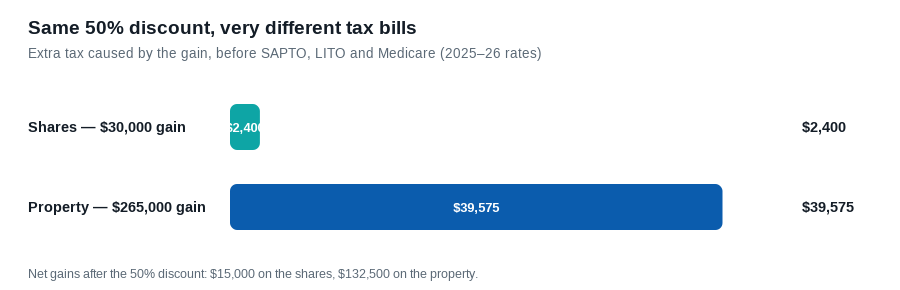
The same 50% discount, very different bills — the property gain is almost nine times the shares gain, and the extra tax follows it.
What is changing from 1 July 2027?
This is now law, not a proposal. On 12 May 2026, as part of the federal Budget 2026-27, the Australian Government announced it would reform CGT arrangements. The first stage, in the Treasury Laws Amendment (Tax Reform No. 1) Act 2026, is now law. These changes do not apply to the 2025-26 tax return.
From 1 July 2027, the CGT changes will:
- replace the 50% CGT discount for resident individuals, trusts and partnerships with cost base indexation on gains that accrue on or after 1 July 2027
- introduce a minimum 30% tax for individuals on certain net capital gains which accrue on or after 1 July 2027
- subject those with pre-CGT assets to CGT for gains accruing on or after 1 July 2027
There are no changes to the meaning of a CGT asset, the framework of a CGT event, or the main residence exemption.
Cost base indexation adjusts an asset’s purchase price for inflation using the consumer price index (CPI) before calculating the capital gain. You still need to have owned the asset for at least 12 months to qualify.
For assets owned before 1 July 2027 and sold on or after that date, the gain up to 1 July 2027 is treated under the current arrangements, and the gain after that date is treated under the new arrangements, using the asset’s value at 1 July 2027 as its cost base. The 50% discount applies to the difference between the asset’s cost base and its value immediately before 1 July 2027.
You can choose to continue to apply the current arrangements and the 50% discount for assets that are new residential dwellings, or used to provide affordable housing.
Assets purchased before 20 September 1985 will continue to be exempt for gains accrued before 1 July 2027. The new arrangements will then apply to any gains accrued on or after 1 July 2027.
The 2027-28 tax return will be the first return that could be affected. You will generally need to establish what the market value of your asset was immediately before 1 July 2027 when you later dispose of it.
Source: ATO, Capital gains tax reform, published 13 October 2026.
Common myths, checked
“I’m on the Age Pension, so I don’t pay CGT.” False. There is no pensioner CGT exemption. CGT depends on the asset and its use.
“Selling the family home is always tax-free.” Mostly true, with traps. The full exemption only applies if it was your main residence for the whole ownership, was never used to produce income, is on 2 hectares or less, and you are an Australian resident. Renting out part or all of it, running a business from it, or holding it rented for more than 6 years after moving out can make part of the gain taxable. Selling does not create CGT, but it does convert an assets-test-exempt home into assessable cash or super for the Age Pension.
“Downsizing into super avoids tax and protects my pension.” Two different things. The home sale itself is usually CGT-free because of the main residence exemption, not because of the downsizer rule. Moving money from an exempt home into super makes it assessable for the Age Pension. It does not shelter the proceeds.
“Inheriting a house means no CGT, ever.” False. There is no CGT when you inherit. There is CGT when you sell, unless the 2-year rule or the main residence of a spouse, occupant or beneficiary rule gives a full exemption. An inherited investment property gets no 2-year exemption.
“A capital gain won’t affect my Age Pension because it’s a one-off.” Misleading. The gain itself is not separately counted as income under deeming, but the proceeds are assessable assets, and deemed income starts on cash proceeds from a property sale.
“Super in pension phase means no tax on anything, for any amount.” Mostly true, capped. Earnings are tax-free only up to your personal transfer balance cap. Excess stays in accumulation at 15%.
“The 50% CGT discount will be there forever.” Not after 1 July 2027, under the reform above. Gains accrued before 1 July 2027 keep the discount, under the transitional rules.
FAQs about CGT and pensions
Do pensioners pay capital gains tax in Australia?
Yes, if they sell a taxable asset and do not meet an exemption. Being on the Age Pension or being retired does not exempt you from CGT. The main residence exemption and the 50% discount are what protect most retirees.
Is my family home exempt from CGT if I move into aged care?
For CGT, moving into aged care does not itself end the exemption. You can rent the former home for up to 6 years and it can still be fully exempt, or leave it vacant indefinitely. For the Age Pension, the home is generally exempt from the assets test for 2 years from entry into care, unless your partner still lives there.
Will selling shares affect my Age Pension?
The gain itself is not counted separately as income — shares and cash are deemed. The proceeds do count in full under the assets test, so a large sale can reduce or stop your pension if it pushes your total assessable assets over the limit.
What is the small business CGT retirement exemption?
It lets you disregard up to $500,000 of capital gains from active small business assets over your lifetime. If you are under 55, the exempt amount must go into super. If you are 55 or older, there is no super requirement.
What happens to the 50% CGT discount in 2027?
From 1 July 2027, it is replaced by cost base indexation for gains accruing on or after that date, for resident individuals, trusts and partnerships. Gains accrued before 1 July 2027 keep the discount under transitional rules. The main residence exemption is unchanged.
This post is general information, not tax advice. Figures are from the ATO and Services Australia as at 18 November 2026, for the 2025-26 and 2026-27 years unless stated otherwise. Tax rates, thresholds and deeming rates are indexed regularly. Check the ATO and Services Australia for your own circumstances, or speak to a registered tax agent.
Want to check your own pay and tax? Use our free Weekly Tax Calculator or browse the Tax Blog.
Calculate Your Exact Weekly Tax
Enter your pay details and instantly see your PAYG tax, Medicare levy, and take-home pay.
Open the Calculator