
Medicare Levy Thresholds 2026–27: What You'll Pay and How the Surcharge Works
By Easha · Tax accountant, Sydney
The Medicare levy is 2% of your taxable income in 2026–27 — but you pay nothing below $28,011 and a reduced amount up to $35,013. Here's the full threshold table, the surcharge tiers, and worked examples.
Key takeaways
- The Medicare levy is 2% of your taxable income in 2026–27. Most Australian residents for tax purposes pay it.
- If you are single and your taxable income is $28,011 or less, you pay no levy at all. Between $28,011 and $35,013 it shades in at 10 cents for each dollar above $28,011.
- Seniors and pensioners who get the seniors and pensioners tax offset get higher thresholds: no levy up to $44,268, shading in to $55,335.
- Families get a higher threshold too: no levy if family taxable income is $47,238 or less, plus $4,338 for each dependent child.
- The Medicare levy surcharge is a separate charge of 1% to 1.5%. It only applies if your income is above $105,000 (single) or $210,000 (family) and you don’t hold appropriate private hospital cover.
- The thresholds for 2026–27 are unchanged from 2025–26.
The Medicare levy is the line on your tax return that funds Medicare, Australia’s public health system. It is not part of the income tax brackets — it sits on top of them. On a taxable income of $90,000, for example, the levy is $1,800, on top of whatever income tax you pay.
But not everyone pays the full 2%. If your income is low, you pay nothing, or a reduced amount that shades in gradually. And the levy is not the same thing as the Medicare levy surcharge — a separate charge that only hits higher earners without private hospital cover. This guide covers both, with the 2026–27 figures and worked examples.
This is general information, not tax or financial advice. The figures come from the ATO pages linked below — check them, or speak to a registered tax agent, for your own circumstances.
The Medicare levy in 2026–27
The levy is 2% of your taxable income — the same figure your income tax is calculated on, after deductions. It applies to most Australian residents for tax purposes. Foreign residents for tax purposes are generally exempt, and there are medical and other exemption categories, covered below.
| 2026–27 | |
|---|---|
| Levy rate | 2% of taxable income |
| Single — no levy at or below | $28,011 |
| Single — full 2% from | $35,013 |
| Single with seniors and pensioners tax offset — no levy at or below | $44,268 |
| Single with seniors and pensioners tax offset — full 2% from | $55,335 |
| Family — no levy at or below | $47,238 |
| Family — full 2% from | $59,047 |
The family thresholds rise with each dependent child: add $4,338 to the lower threshold and $5,423 to the upper threshold for each child. If you are entitled to the seniors and pensioners tax offset, the family upper threshold is $77,028 instead of $59,047.
These thresholds apply for 2026–27 and are unchanged from 2025–26.

The levy doesn’t switch on all at once — it shades in at 10 cents for every dollar your income sits above the lower threshold.
How the shade-in works
The levy does not switch on all at once. Below the lower threshold you pay nothing. Above the upper threshold you pay the full 2% on your whole taxable income. In between, the levy shades in at 10 cents for every dollar your income sits above the lower threshold.
That matters because the shade-in is much cheaper than the full levy. At $30,000 of taxable income, the full 2% would be $600 — but the shade-in means you pay only $198.90.
Worked examples: single, no dependants
| Taxable income | How the levy is worked out | Medicare levy |
|---|---|---|
| $25,000 | Below $28,011 — no levy | $0 |
| $28,011 | Exactly at the threshold — no levy | $0 |
| $29,000 | 10% × ($29,000 − $28,011) = 10% × $989 | $98.90 |
| $30,000 | 10% × ($30,000 − $28,011) = 10% × $1,989 | $198.90 |
| $32,000 | 10% × ($32,000 − $28,011) = 10% × $3,989 | $398.90 |
| $35,013 | 10% × ($35,013 − $28,011) = 10% × $7,002 | $700.20 |
| $35,014 | Full 2% applies: 2% × $35,014 | $700.28 |
| $50,000 | Full 2%: 2% × $50,000 | $1,000 |
| $90,000 | Full 2%: 2% × $90,000 | $1,800 |
| $150,000 | Full 2%: 2% × $150,000 | $3,000 |
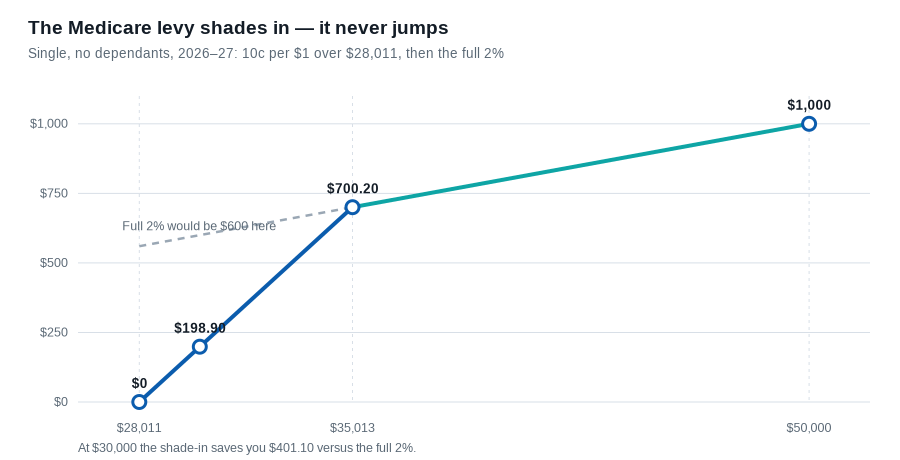
The blue line is what you actually pay. The dashed line is the full 2% with no shade-in — at $30,000 the shade-in saves you $401.10.
Notice how the shade-in meets the full levy almost exactly at the upper threshold — $700.20 shaded in at $35,013 versus $700.28 at the full 2% on $35,014. That is the point of the design: there is no sudden jump in your tax bill as your income crosses the threshold.
Worked example: a family
A couple with no dependent children has a combined family taxable income of $55,000. The family lower threshold is $47,238 and the upper threshold is $59,047, so they are inside the shade-in range.
The levy for the family works out to 10% × ($55,000 − $47,238) = 10% × $7,762 = $776.20 between them. The ATO works out the reduction and apportions it between the two spouses — you don’t need to do that split yourself.
If the same couple had one dependent child, their lower threshold would be $47,238 + $4,338 = $51,576 and their upper threshold $59,047 + $5,423 = $64,470. On $55,000 of family income, their levy would be 10% × ($55,000 − $51,576) = $342.40.
Who doesn’t have to pay the levy
You may be able to claim a full or half exemption from the Medicare levy if, at any time during the year, you were in one of these categories:
- Medical: you were a blind pensioner, or entitled to full free medical treatment for all conditions under defence force arrangements or a Department of Veterans’ Affairs Gold Card.
- Foreign resident: you were a foreign resident for tax purposes for the whole year (full exemption), or for part of the year (exemption for that period, if you had no dependants or all your dependants were also exempt).
- Not entitled to Medicare benefits: you hold a Medicare Entitlement Statement from Services Australia showing you were not entitled to Medicare benefits because you were a temporary resident for Medicare purposes.
If you were not an Australian resident for tax purposes for the whole year, you may be exempt — but the reduction and the exemption are worked out separately, so check both parts of the ATO’s M1 guidance before you lodge.

Two different charges: the levy funds Medicare for everyone, while the surcharge only applies to higher earners without private hospital cover.
The Medicare levy surcharge: a different charge
The surcharge is often confused with the levy, but it is a separate charge with a different purpose. The levy funds Medicare for everyone. The surcharge is an extra charge on higher earners who don’t hold private patient hospital cover — it is designed to encourage people who can afford it to take out hospital cover and ease pressure on the public system.
The key differences:
| Medicare levy | Medicare levy surcharge | |
|---|---|---|
| Who pays | Most residents | Only higher earners without appropriate hospital cover |
| Rate | 2% of taxable income | 1%, 1.25% or 1.5% of income for surcharge purposes |
| Can hospital cover remove it? | No — the levy applies regardless | Yes — appropriate hospital cover means no surcharge |
| Based on | Taxable income | Income for surcharge purposes |
Income for surcharge purposes is broader than taxable income. It includes your taxable income plus your total reportable fringe benefits and any amount on which family trust distribution tax has been paid — so your income for surcharge purposes can be higher than the taxable income on your return.
Surcharge thresholds and rates, 2026–27
| Base tier | Tier 1 | Tier 2 | Tier 3 | |
|---|---|---|---|---|
| Single | $105,000 or less | $105,001 – $123,000 | $123,001 – $164,000 | $164,001 or more |
| Family | $210,000 or less | $210,001 – $246,000 | $246,001 – $328,000 | $328,001 or more |
| Surcharge rate | 0% | 1% | 1.25% | 1.5% |
The family threshold rises by $1,500 for each Medicare levy surcharge dependent child after the first child.
Worked example: the surcharge on $117,000
Tom is 35, single, and doesn’t hold the appropriate level of private patient hospital cover. In 2026–27 his income for surcharge purposes is $117,000.
That puts him in Tier 1 for a single person ($105,001 – $123,000), so the surcharge rate is 1%. His surcharge is 1% × $117,000 = $1,170.
On top of that, Tom still pays the Medicare levy itself: 2% × $117,000 = $2,340 (assuming his taxable income is also $117,000). So his total Medicare charges for the year are $2,340 + $1,170 = $3,510.
If Tom had held appropriate private patient hospital cover for the full year, he would pay the $2,340 levy but no surcharge at all — a saving of $1,170.
When the surcharge doesn’t apply
You don’t pay the surcharge if:
- your income for surcharge purposes is at or below the base tier ($105,000 single, $210,000 family); or
- you (and your dependants, if any) held an appropriate level of private patient hospital cover for the whole year — generally hospital cover with an excess of $750 or less for singles, or $1,500 or less for families.
If you held cover for only part of the year, the surcharge is worked out on a pro-rata basis for the days you were uncovered.
Levy and surcharge together: three households
| Household | Income | Medicare levy | Surcharge | Total |
|---|---|---|---|---|
| Single, $30,000 taxable income | $30,000 | $198.90 (shaded in) | $0 | $198.90 |
| Single, $90,000, no hospital cover | $90,000 | $1,800 | $0 (under $105,000) | $1,800 |
| Single, $117,000, no hospital cover | $117,000 | $2,340 | $1,170 (Tier 1) | $3,510 |
| Family, $230,000, no hospital cover | $230,000 | $4,600 | $2,300 (Tier 1: 1% × $230,000) | $6,900 |
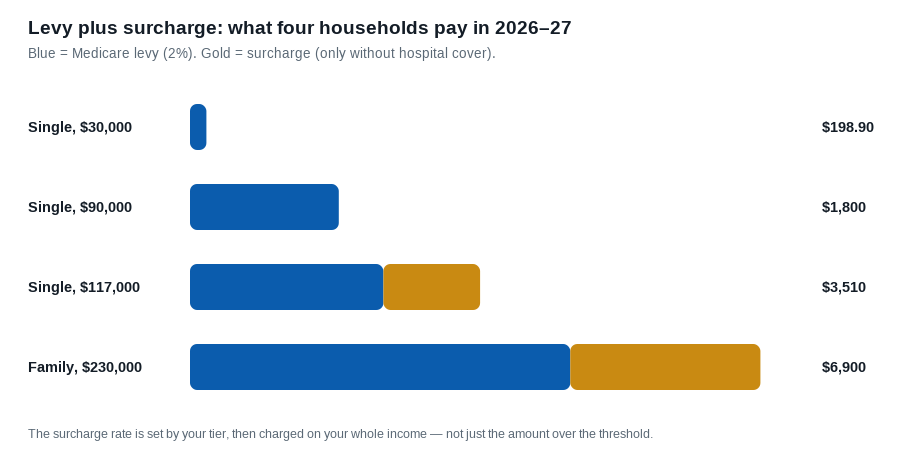
Blue is the levy everyone pays; gold is the surcharge, which only applies without hospital cover.
That last row is worth a second look: a family on $230,000 without hospital cover pays a 1% surcharge on the full $230,000 — not just the amount above the threshold. The surcharge rate is set by your tier, then applied to your whole income for surcharge purposes.
FAQs about the Medicare levy
Is the Medicare levy going up in 2026–27?
No. The levy stays at 2% of taxable income, and the low-income thresholds are unchanged from 2025–26 — $28,011 for singles and $47,238 for families.
Do I pay the levy if I have private health insurance?
Yes. Private health insurance never removes the Medicare levy — it only removes the surcharge. Everyone who pays the levy pays it whether or not they hold cover.
What is the difference between the levy and the surcharge?
The levy is 2% of taxable income and applies to most residents. The surcharge is an extra 1% to 1.5% that only applies to higher earners (above $105,000 single or $210,000 family) who don’t hold appropriate private patient hospital cover.
I earn under $28,011. Do I need to do anything on my tax return?
If your taxable income is at or below your lower threshold, you don’t pay the levy and you don’t write anything at the Medicare levy question (M1) on your return. The ATO works out any reduction for you if you’re in the shade-in range.
Does the levy apply to my whole income or just the amount above the threshold?
Once you are above the upper threshold, the 2% applies to your whole taxable income — not just the amount above the threshold. That is why the shade-in range exists: it stops the levy jumping from $0 to the full 2% overnight.
I’m a foreign resident. Do I pay the levy?
If you were a foreign resident for tax purposes for the whole year, you can generally claim a full exemption. If you were a foreign resident for only part of the year, you may be able to claim an exemption for that period. Check the ATO’s exemption categories before you lodge.
This post is general information, not tax or financial advice. Figures are from the ATO as at 21 November 2026, for the 2026–27 income year unless stated otherwise. Check the ATO pages below or speak to a registered tax agent for your own circumstances.
Sources: ATO, Medicare levy surcharge income, thresholds and rates; ATO, M1 Medicare levy reduction or exemption 2026.
Want to check your own pay and tax? Use our free Weekly Tax Calculator or browse the Tax Blog.
Calculate Your Exact Weekly Tax
Enter your pay details and instantly see your PAYG tax, Medicare levy, and take-home pay.
Open the Calculator